The European Institute for Peace and Governance (EIPG)
In recent months, platforms such as TikTok, Facebook, and Telegram have been flooded with carefully produced short videos: dramatic music, martial chants, rapid editing, and footage of children or teenagers carrying weapons, smiling, or chanting military slogans.
These clips attempt to polish the image of war, presenting it as heroism or adventure, while completely ignoring the risks children later face — death, injury, or long-term psychological trauma.
The recruitment and use of children in armed conflict constitute a war crime under international law, particularly when the evidence is public and widely circulated, rather than confined to confidential reports or sealed documents.
As these scenes are repeatedly shared, widely disseminated, and marked by strikingly similar visual patterns, difficult questions arise: How do these children appear in such settings? How were they recruited? And where does legal responsibility lie in a conflict that ranks among the deadliest in the region?
According to United Nations reports, grave violations against children have been documented since the outbreak of the war, including killing, maiming, recruitment, and use in hostilities. In this context, wars that draw children into their battlefields do not end when the fighting stops. They leave deep scars on an entire generation deprived of its childhood — a generation for whom the weapon may become a marker of identity and self-affirmation, rather than a symbol of death and destruction.
Scattered Clips… A Repeating Scene
Since April 2023, the war in Sudan has devastated cities and residential neighborhoods, displaced millions of civilians, and triggered an unprecedented humanitarian crisis. As fighting drags on and combatant ranks are depleted, the Sudanese Armed Forces (SAF), along with allied militias such as the Al-Baraa bin Malik Brigade affiliated with the Islamic Movement, have increasingly turned to recruiting children in northern Nile River State, viewing them as the “easiest substitute” in a war with no clear end in sight.
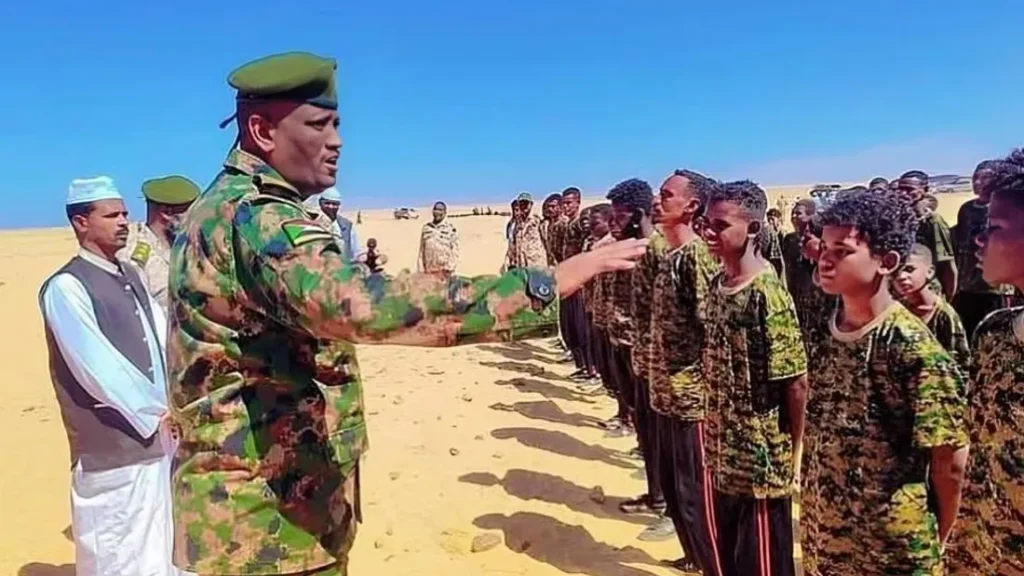
In a number of analyzed materials, Sudanese children appear wearing combat uniforms, standing inside Sudanese military vehicles, or surrounded by armed men from the Al-Baraa bin Malik militia. In other clips, minors speak directly to the camera using explicit military language, including threats or references to ongoing battles.
Rachel Brett, a former researcher on children and armed conflict, notes: “The presence of a single child in a military setting might be an isolated incident. But when the images are repeated, it becomes difficult to dismiss them as coincidence.”
In many of the videos, the children do not appear visibly coerced or frightened. They are seen smiling, flashing victory signs, or speaking confidently to the camera. According to specialists, this image does not necessarily reflect the reality of children within armed conflict. Rather, it may be the product of a complex propaganda and psychological environment.
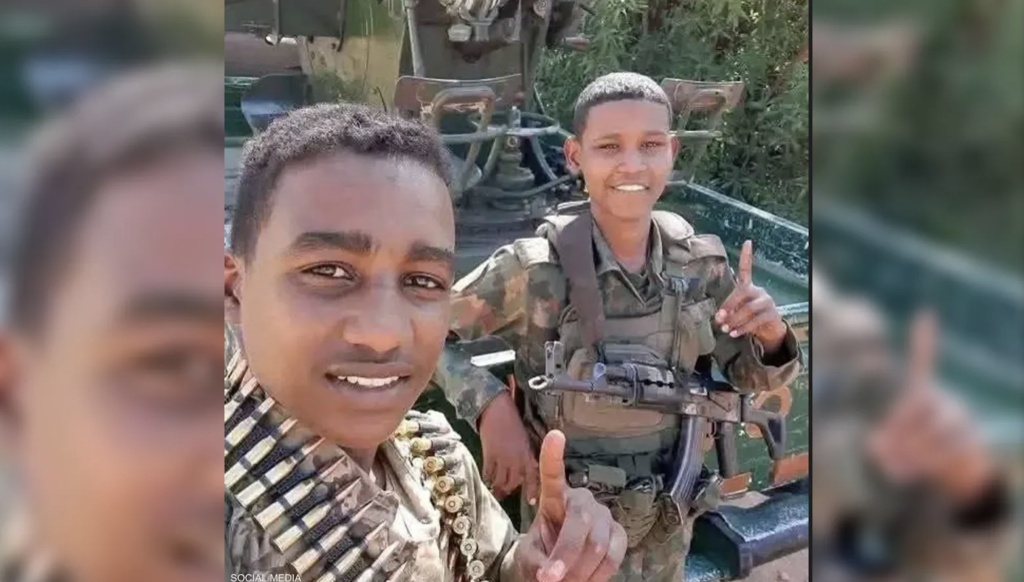
Children have been documented fighting alongside the Sudanese army and allied groups during previous battles in Kordofan, western Sudan.
Sarah Thomas, a researcher in the social psychology of conflict, explains: “Propaganda images do not depict violence as it is lived, but as it is intended to be seen.”
Under the Paris Principles on Children Associated with Armed Forces or Armed Groups — to which Sudan is linked — a child soldier is defined as any person under the age of eighteen who is recruited or used by an armed force or armed group in any capacity, whether or not they take a direct part in hostilities.
International law prohibits the recruitment of children under the age of fifteen or their participation in hostilities, whether compulsory or voluntary. The Optional Protocol to the United Nations Convention on the Rights of the Child on the involvement of children in armed conflict further strengthened these protections by raising the minimum age for compulsory recruitment to eighteen.
War Economy
International warnings have intensified over the use of children in Sudan’s ongoing conflict. Human rights organizations, including UNICEF and Human Rights Watch, have documented cases of child recruitment and exploitation, including children as young as thirteen deployed on the front lines.
These reports indicate that some children are assigned combat roles or, in certain instances, used as human shields — exposing them to direct life-threatening risks and placing them at the center of military operations. Such practices constitute grave violations of international humanitarian law and international conventions prohibiting the recruitment and use of children in armed conflict. Rights organizations continue to call for urgent measures to protect children and to ensure accountability for those responsible.
In Sudan, experts note that several interrelated factors increase children’s and adolescents’ vulnerability to recruitment.
The first factor is economic and social fragility. Years of political instability, economic decline, and mass displacement have produced environments where many children live outside stable protection networks. Interrupted education, unstable family income, and the erosion of traditional social structures reshape the options available to younger generations.
In this context, Veronika Birsand, a researcher on armed conflict and digital media, argues that the appearance of children in war-related propaganda forms part of a broader process of redefining childhood in times of conflict. Presenting children in military uniforms or combat settings, she explains, contributes to normalizing their presence within the space of war, gradually transforming their image from victims in need of protection into mobilizing symbols used within military and propaganda discourse.
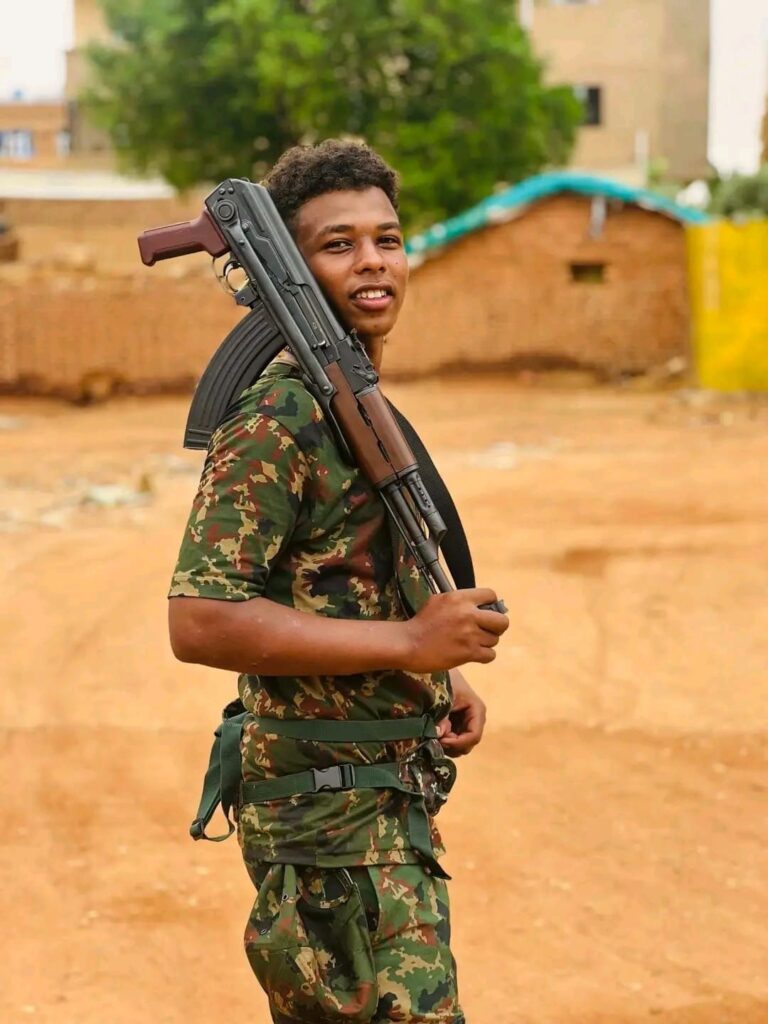
An image shows a child recruited into the Sudanese army, holding a rifle and facing the camera with a smile — as if the war were merely a game, unaware of its brutality and bloodshed.
The second factor relates to the psychological dimension. Children and adolescents are generally more susceptible to adopting absolute narratives, especially those framed in moral, religious, or heroic terms. At this developmental stage, complex concepts such as violence, death, and conflict can be simplified and reframed as symbols of courage, sacrifice, or self-affirmation.
Dr. Sarah Thomas, a researcher in the social psychology of conflict, explains that effective propaganda does not necessarily rely on information as much as it relies on emotional impact. The appearance of children in such materials is not intended merely to show their participation, but to present them as symbolic figures capable of evoking sympathy or admiration — thereby strengthening the persuasive power of the message and its influence on audiences.
The third factor is linked to the structure of war itself. Prolonged conflicts create a continuous demand for fighters. As casualties and defections rise, younger age groups increasingly become an available human reservoir. Minors are often less able to refuse, less aware of long-term risks, and more vulnerable to pressure from authority figures or group dynamics.
Who Is Responsible?
The story of child recruitment does not begin the moment a weapon is placed in a child’s hands, nor does it end with their appearance in video clips. Behind every child shown in a military setting lies a complex chain of decisions, structures, and actors — military, organizational, and media-related — that make their presence within a conflict environment possible in the first place.
In the recorded videos, minors appear within the proximity of armed members of the Sudanese Armed Forces or formations allied with them.
The Al-Baraa bin Malik Brigade emerges repeatedly in this context. Visual materials circulating on social media platforms show minors chanting slogans associated with the brigade or standing alongside fighters who identify themselves as members of it.
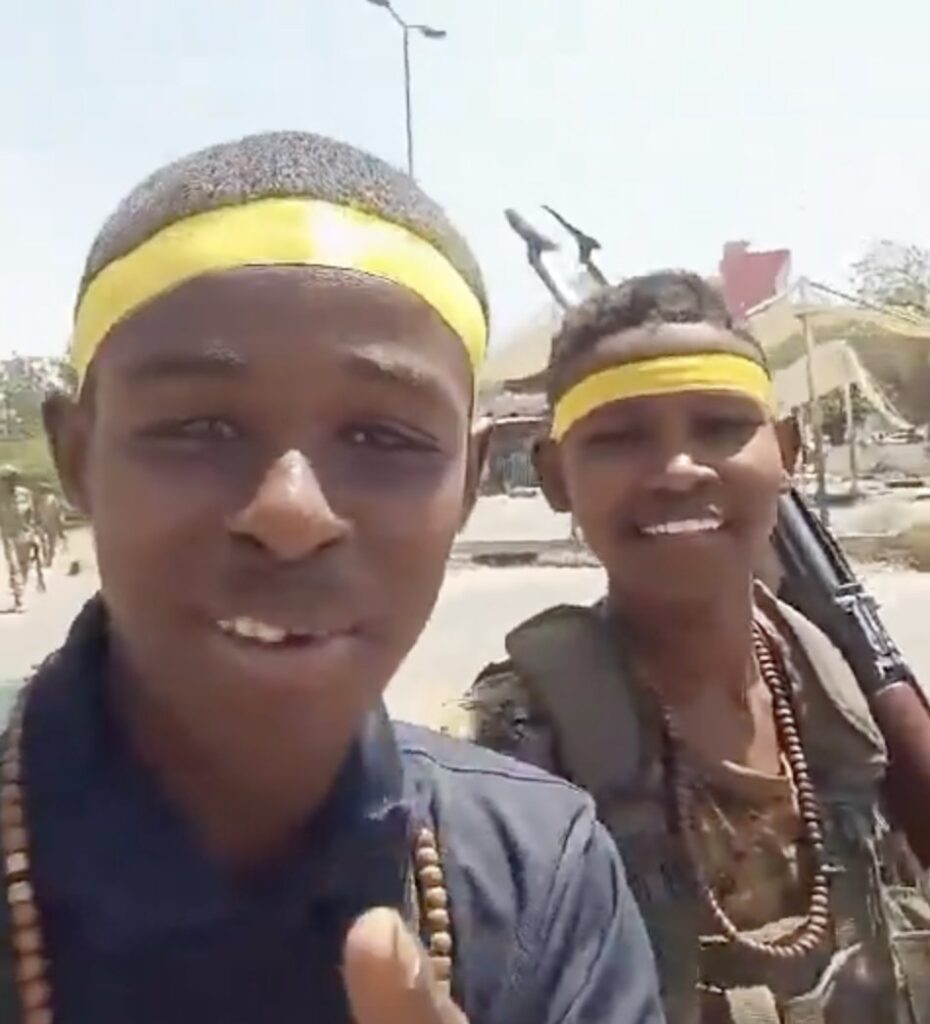
Children recruited and fighting on the Khartoum front alongside the Al-Baraa bin Malik Corps, an Islamist brigade allied with the Sudanese Armed Forces.
Mark Linden, a lawyer and expert in international humanitarian law, explains: “The recruitment of children is not viewed as an isolated individual incident, but as an indicator of a failure in command and control structures. Responsibility does not rest solely with the person who directly recruited the child; it extends to any authority that had the capacity to prevent it and failed to do so.”
In armed conflicts, parties exercising control over territory — whether regular forces or allied formations — bear direct legal obligations to protect minors and prevent their involvement in military activities. The presence of children within armed environments, or their appearance in war-related narratives, raises legal questions about mechanisms of prevention, oversight, and discipline.
Accountability, however, is not limited to military actors. The circulation of digital content depicting minors in combat or quasi-combat situations also highlights the responsibilities of technology companies and the effectiveness of content moderation mechanisms related to conflict and child protection.
A member of the UN Human Rights Council’s Fact-Finding Mission on Sudan stated that factions affiliated with the Sudanese Armed Forces have engaged in the “systematic recruitment and use of children in hostilities.” This included deploying minors in direct combat roles, as well as assigning them tasks such as manning checkpoints, documenting violations, and disseminating related materials on social media.
How Does Recruitment Happen?
Recruitment in armed conflicts is no longer confined to training camps or local intermediary networks. In Sudan — as in other contemporary conflicts — digital platforms have become a central arena for reproducing war narratives and reaching younger audiences, often beyond effective institutional or familial oversight.
Algorithms play a pivotal role in this process. Content that generates high engagement is automatically amplified and pushed to wider audiences, regardless of its nature or sensitivity. In the context of armed conflict, this technical logic can transform propaganda or mobilization materials into widely circulated content within a short period.
Digital recruitment does not always take an explicit form. Rarely do videos contain direct calls to join the fighting. Instead, a more complex psychological narrative is constructed, framing war as a space of heroism, belonging, and identity. Military participation is portrayed as an experience of strength, courage, and social recognition — elements that can hold particular appeal for adolescents.
In circulating clips, children or young boys appear in celebratory or performative poses: smiling at the camera, flashing victory signs, or chanting combat slogans. These scenes function not merely as visuals, but as mechanisms of psychological normalization around the idea of bearing arms. Violence is not presented as danger or tragedy, but as a symbol of heroism and belonging.
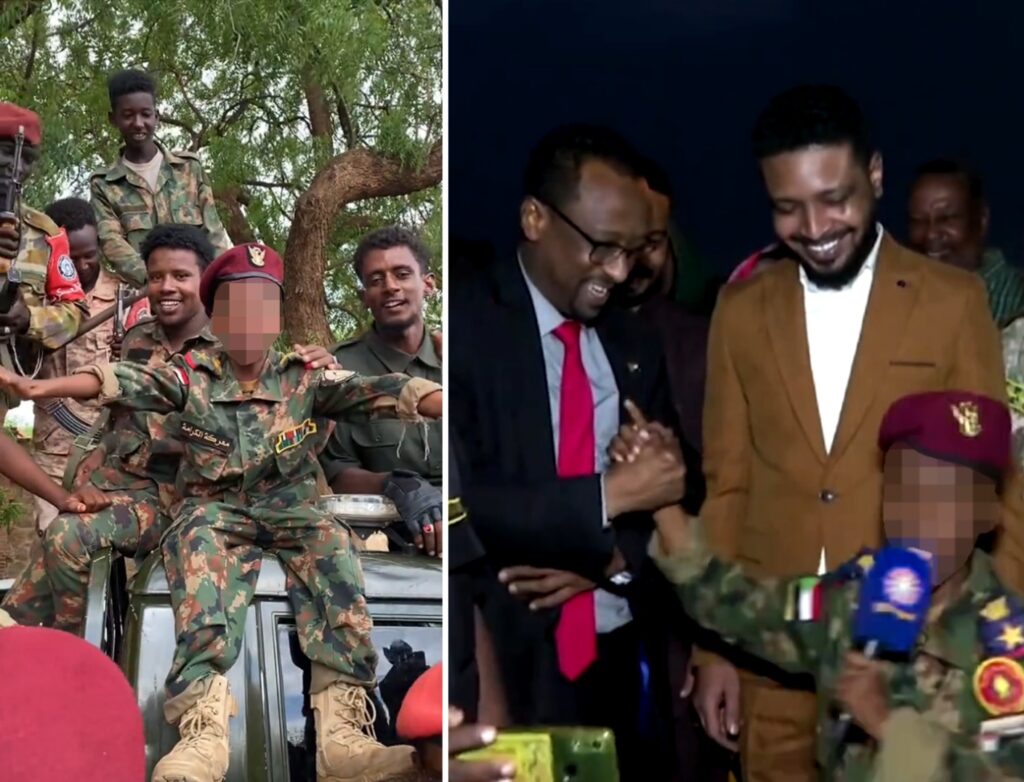
On the left: a still image from a TikTok video that garnered 1.3 million views, showing a child in military uniform accompanied by armed soldiers, threatening the Rapid Support Forces (RSF). On the right: the same child holding hands with Khalid Al-Aiser, Sudan’s Minister of Culture and Information.
According to Mohammed Hussein, a retired brigadier from the Sudanese army, child recruitment began years ago through more traditional forms of forced enlistment. “Today, we are seeing recruitment carried out through different methods,” he adds. “The involvement of minors in armed conflict constitutes a war crime and causes serious damage to the reputation of any military institution.”
From Screen to Front Line: What Does the Life of a Recruited Child Look Like?
Behind the video clips, the martial chants, and the images that spread rapidly across screens lies a very different daily reality. Recruited children are absorbed into military or شبه-military structures that impose rigid lifestyles, where obedience and discipline become part of the daily routine. The tasks assigned to them are closely tied to the logic of war and its inherent risks.
According to the latest United Nations report on Children and Armed Conflict, at least 209 verified cases of child recruitment and use in combat were documented in Sudan in 2023 alone — a marked increase compared to previous years.
The report indicates that children were used in multiple roles, including direct participation in hostilities, as well as support functions such as guarding, transporting supplies, and reconnaissance. The phenomenon is not limited to direct recruitment; it also extends to more complex ideological and propaganda dimensions, where children are deployed within mobilizing rhetoric and conflict-related media content.
The impact, however, goes beyond physical danger. Specialized studies show that children associated with armed conflict face long-term psychological consequences. Direct exposure to violence, loss of safety, and forced involvement in combat environments can leave profound effects on psychological and behavioral development.
Marit Eriksson, a mental health expert specializing in conflict-related trauma, explains: “Children involved in armed conflicts experience high rates of post-traumatic stress disorder, chronic anxiety, and sleep disturbances. Many also suffer from emotional numbness, aggressive episodes, and difficulties with social reintegration later in life.”
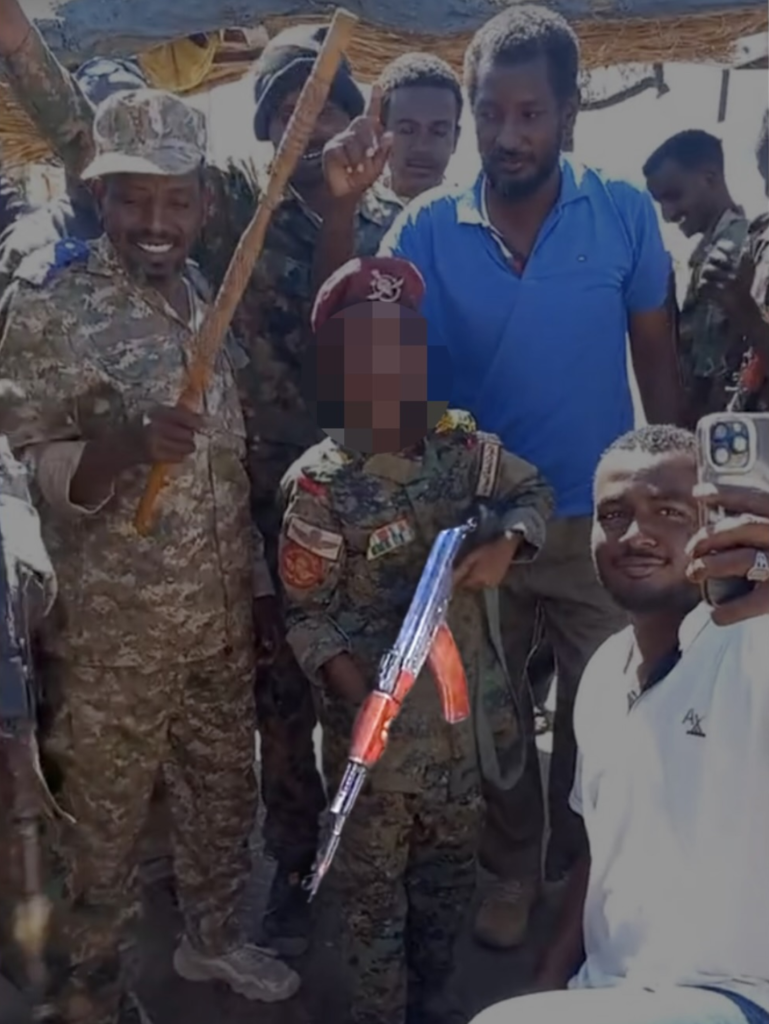
Screenshots of social media posts showing a child associated with the Sudanese army.
International organizations such as Amnesty International warn that the most dangerous consequences of recruitment may emerge after a child leaves the armed environment. Disruption of education, the erosion of family ties, and normalization of violence can complicate reintegration into civilian life. For many children, the end of fighting does not mark the end of the experience, but rather the beginning of a long process of coping with its aftermath.
Legal Framework: How Does International Law View Child Recruitment?
The recruitment of children in armed conflict is not treated merely as a moral or humanitarian issue. Under international law, it is classified as one of the gravest violations associated with war. Over decades, a strict legal framework has developed, establishing clear restrictions on the involvement of minors in military activities and recognizing such practices as direct breaches of the laws of armed conflict.
This framework is grounded in a fundamental principle of international humanitarian law: children are entitled to special protection due to their vulnerability and their inability to provide free and informed consent to participate in violence. Therefore, the presence of a child in a combat context is not legally interpreted as an individual choice, but as a responsibility borne by the actors who permitted, facilitated, or imposed that presence.
The Convention on the Rights of the Child serves as the primary reference in this field, obligating states to take all feasible measures to prevent minors from participating in hostilities. The Optional Protocol on the involvement of children in armed conflict further strengthened these protections, imposing stricter limits on compulsory recruitment and the use of individuals under the age of eighteen.
The criminal dimensions of these practices are clearly reflected in the Rome Statute of the International Criminal Court, which classifies the conscription or enlistment of children under fifteen and their use in hostilities as a war crime. Criminal responsibility is not limited to bearing arms or direct combat participation; it extends to any military or quasi-military role connected to combat operations.
Accountability does not stop with direct perpetrators. International law recognizes the principle of command responsibility, which allows for the prosecution of military commanders, administrative officials, and any individuals involved in facilitating, organizing, or knowingly allowing the involvement of minors in armed conflict.
In the Sudanese context, these legal standards remain fully applicable. The circumstances of war or claims of military necessity do not provide exemptions when it comes to protecting children from recruitment or use in conflict.
What Must Happen to Stop Child Recruitment?
The United Nations plays a central role in documenting violations related to children and armed conflict. Strengthening monitoring and reporting mechanisms, and ensuring field access for verification teams, is essential to understanding the true scale of the phenomenon and identifying responsibility.
The UN Secretary-General’s reports are also regarded as important pressure tools that can influence the behavior of warring parties through listing mechanisms and international accountability processes.
Several measures are required:
1. Clear Commitments from All Parties Involved
Primary responsibility lies with all actors engaged in recruitment practices. International law imposes an explicit obligation to prevent the recruitment or use of minors in any role connected to military operations. This includes:
- Issuing clear internal orders prohibiting the involvement of minors
- Establishing age-verification mechanisms within military units
- Immediately demobilizing children associated with armed formations
- Ensuring they are not re-recruited
2. Effective Accountability Mechanisms
The absence of accountability is a key factor enabling the continuation of these practices. Activating accountability tools — whether through national or international mechanisms — is essential to prevent those responsible for child recruitment from acting with impunity.
3. Economic and Social Protection for Vulnerable Groups
Experiences from other conflicts show that economic vulnerability is a major driver of child recruitment. Improving access to education, humanitarian assistance, and social protection programs can reduce minors’ susceptibility to recruitment.
Humanitarian organizations stress that child protection does not begin on the battlefield, but within the communities where children live.
4. Responsibility of Digital Platforms
As much of the war narrative shifts into digital spaces, technology companies bear increasing responsibility in limiting the circulation of content depicting children in combat or military propaganda contexts. This requires platforms to:
- Strengthen automated monitoring systems for child- and conflict-related content
- Accelerate removal mechanisms for harmful materials
- Develop policies more sensitive to war contexts
- Cooperate with child protection organizations
5. Rehabilitation and Reintegration Programs
For children who have already been recruited or used in conflict, demobilization does not mark the end of the crisis. Psychosocial support, access to education, and social reintegration programs are critical to mitigating the long-term effects of conflict.
6. International Fact-Finding and Investigative Mechanisms
Independent fact-finding missions represent one of the few available tools for documenting violations in environments where direct judicial access is limited. Legal experts emphasize that supporting these commissions, expanding their mandates, and ensuring witness protection can strengthen prospects for future accountability.
7. The Role of the European Union and International Donors
The European Union and international donors play an influential role through diplomatic leverage and aid programs. Linking political and economic support to compliance with child protection standards can serve as a significant deterrent mechanism. The EU can also support rehabilitation and reintegration programs for children affected by conflict, as well as fund child protection initiatives and human rights monitoring efforts.