European Institute for Peace and Governance (EIPG)
Abstract
The escalation of war involving Iran represents one of the most serious geopolitical shocks to the global energy system in decades. The Persian Gulf region remains the epicenter of the world’s oil supply network, and any disruption in this region reverberates rapidly across international markets. At the center of this vulnerability lies the Strait of Hormuz, a narrow maritime corridor through which a substantial portion of the world’s oil and liquefied natural gas shipments pass.
This research examines the potential global economic consequences of the Iran war, focusing on energy markets, maritime shipping routes, and the evolving architecture of global energy security. The study argues that the crisis represents not merely a regional conflict but a structural stress test for the global energy system.
A prolonged disruption in Gulf energy flows could trigger systemic economic consequences including energy price shocks, supply chain disruption, inflationary pressures, and geopolitical realignment among major energy consumers and producers. The research concludes that the Iran war could accelerate structural shifts in global energy governance, including diversification of supply routes, expansion of strategic reserves, and a faster transition toward alternative energy systems.
1. Introduction: War in the World’s Energy Heartland
Modern global economies are deeply dependent on stable energy supply chains. Oil and natural gas remain critical inputs for industrial production, transportation systems, electricity generation, and global trade.
Despite growing investments in renewable energy, the global economy remains structurally tied to fossil fuel systems.
This dependence creates a strategic vulnerability: geopolitical conflict in key energy-producing regions can rapidly destabilize the global economy.
The Iran war represents precisely such a shock.
The Middle East contains nearly half of the world’s proven oil reserves and a large share of global natural gas production. The region’s energy exports supply major industrial economies across Asia, Europe, and beyond.
Because much of this energy is transported by sea, maritime chokepoints play a crucial role in maintaining the stability of global markets.
Among these chokepoints, the Strait of Hormuz is by far the most critical.
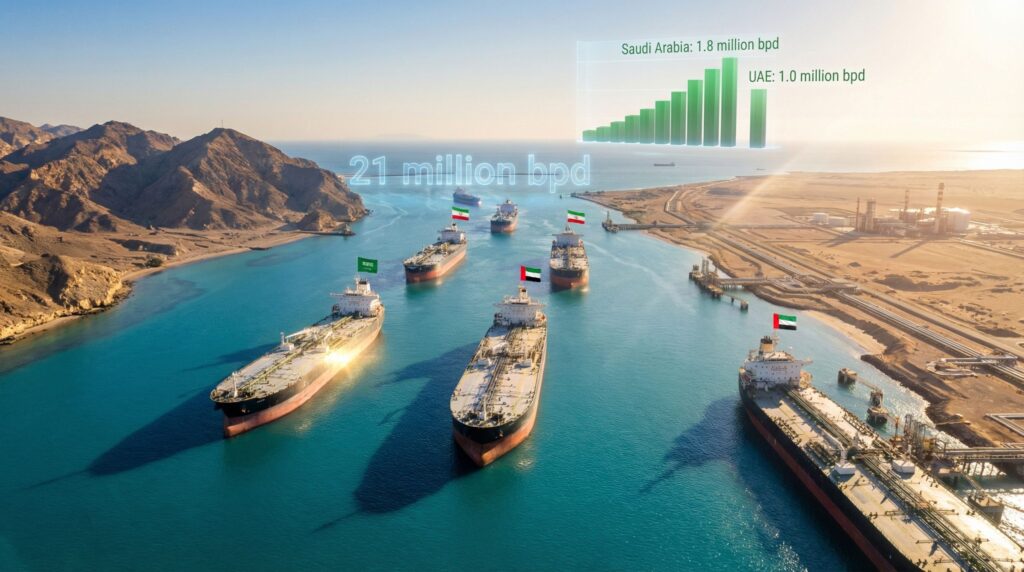
Approximately 20 million barrels of oil pass through the strait each day, representing roughly 20% of global petroleum consumption.
In addition, the corridor carries nearly a quarter of global seaborne oil trade and a significant portion of global LNG shipments.
As tensions escalate around Iran, the vulnerability of this corridor has become a central concern for policymakers, investors, and global security planners.
2. Oil Markets Under Shock
Energy markets react quickly to geopolitical uncertainty.
Even before physical supply disruptions occur, the expectation of potential disruption can trigger dramatic price volatility.
When conflict involving Iran escalated in previous crises, oil markets responded almost immediately with sharp price increases due to fears of supply interruption.
Energy traders typically incorporate what is known as a “risk premium” into oil prices during geopolitical crises.
This premium reflects uncertainty about future supply stability.
In the case of the Iran war, several factors drive this volatility:
- Threats to maritime shipping in the Persian Gulf
- Potential attacks on oil infrastructure
- Increased insurance costs for tanker fleets
- Strategic stockpiling by governments
Oil markets are particularly sensitive to disruptions in the Middle East because the region remains one of the few areas capable of rapidly adjusting production levels.
However, if conflict spreads to major oil-producing states, global spare production capacity could quickly be exhausted.
This would push prices dramatically higher.
Some analysts have suggested that a full disruption of Gulf energy flows could drive oil prices above $120 per barrel, triggering severe economic consequences worldwide.
3. The Fragility of Maritime Energy Routes
The modern energy system relies heavily on maritime shipping.
Approximately 90% of global trade is transported by sea, making maritime logistics the backbone of the global economy.
Oil transportation is particularly dependent on tanker fleets navigating a network of narrow maritime corridors.
Several chokepoints dominate this system:
- Strait of Hormuz
- Bab el-Mandeb
- Suez Canal
- Strait of Malacca
Among these, the Strait of Hormuz is the most strategically sensitive.
More than one quarter of global maritime oil trade passes through this narrow corridor each year.
The corridor’s geography amplifies its vulnerability.
At certain points, shipping lanes are only a few kilometers wide.
This makes vessels highly exposed to threats such as:
- naval mines
- missile attacks
- drone strikes
- maritime sabotage
Even limited attacks on tanker traffic can have cascading effects across global supply chains.
4. Insurance, Shipping Costs, and Trade Disruption
Maritime conflict affects global trade not only through physical damage but also through financial risk.
Shipping companies rely on maritime insurance markets to protect vessels and cargo.
During periods of conflict, insurance premiums rise dramatically.
In extreme cases, insurers may refuse coverage entirely.
When this happens, shipping companies may suspend operations in high-risk zones.
This phenomenon has already been observed in recent crises involving Gulf shipping lanes.
When tanker traffic slows or stops, energy supply chains become severely constrained.
Ships may be forced to reroute through longer alternative routes, increasing transportation costs and delivery times.
These disruptions can ripple through global supply chains, affecting industries far beyond the energy sector.
5. The Inflationary Impact
Energy prices are deeply embedded in the global economy.
Oil price increases affect:
- transportation costs
- manufacturing expenses
- food production
- electricity generation
Because energy costs influence nearly every sector, oil price shocks often translate into broader inflationary pressure.
This dynamic has historically played a major role in global economic downturns.
For example, the oil shocks of the 1970s triggered widespread inflation and economic stagnation across many advanced economies.
A similar dynamic could emerge if the Iran war significantly disrupts Gulf energy exports.
Inflationary pressure could force central banks to maintain higher interest rates, slowing economic growth.
Developing economies would be particularly vulnerable to such shocks.
6. Asia’s Exposure to Gulf Energy
Asian economies are particularly dependent on energy imports from the Persian Gulf.
Countries such as:
- China
- India
- Japan
- South Korea
rely heavily on Gulf oil and LNG shipments for industrial production and electricity generation.
A large share of these shipments travels through the Strait of Hormuz.
In fact, roughly two-thirds of oil exports passing through the strait are destined for Asian markets.
This dependence means that energy disruptions in the Gulf would have particularly severe consequences for Asian economic stability.
Some Asian states have therefore begun accelerating investments in renewable energy and strategic reserves in order to reduce vulnerability to geopolitical shocks.
7. Europe’s Strategic Energy Challenge
Although Europe has diversified energy imports in recent years, the continent remains exposed to global price fluctuations.
European economies rely heavily on energy imports to sustain industrial production and transportation systems.
A major disruption in Gulf energy flows could therefore have serious consequences for:
- industrial output
- energy affordability
- economic growth
The Iran war highlights the importance of building resilient energy systems capable of absorbing geopolitical shocks.
For Europe, this includes expanding renewable energy infrastructure, strengthening strategic petroleum reserves, and developing alternative supply routes.
8. The Long-Term Transformation of Energy Security
While the immediate focus of the Iran war centers on military confrontation, the long-term implications may be structural.
Major geopolitical crises often accelerate economic transformations that are already underway.
The Iran war may accelerate several trends:
- diversification of global energy supply chains
- expansion of renewable energy investment
- development of alternative pipeline networks
- greater emphasis on energy security in national policy
In this sense, the crisis may contribute to the gradual transformation of the global energy system.
9. Geopolitical Realignment
Energy crises frequently reshape geopolitical alliances.
Countries dependent on vulnerable supply routes may seek new strategic partnerships with alternative energy producers.
Meanwhile, energy-exporting states may gain increased geopolitical leverage.
Major powers such as the United States, China, and the European Union will likely compete to secure stable energy supply chains.
In this environment, energy diplomacy becomes a central element of global power politics.
Conclusion
The Iran war represents one of the most significant stress tests for the global energy system in the twenty-first century.
The conflict highlights the fragility of global energy supply chains and the geopolitical risks associated with concentrated production and transportation routes.
The Strait of Hormuz remains the world’s most critical energy chokepoint. Disruptions in this corridor could trigger a cascade of economic consequences affecting global markets, trade systems, and geopolitical alliances.
For policymakers, the lesson is clear: energy security must be treated as a central pillar of global economic stability.
The future of the global energy order will depend on how governments respond to the structural vulnerabilities exposed by the Iran war.