Why in 2026, we must think enlarged
Over the past years, the European institutions have heralded a new momentum for EU enlargement, pledging that it is realistic for up to “two or three” new members to join during this mandate. But if the Union is serious about delivering on that ambition within the current cycle, 2026 must be the year when political rhetoric gives way to operational decisions – on funding, internal reforms and the legal preparations required for the next accession treaty.
And getting real about enlargement also requires ‘thinking enlarged’, which means embedding an enlargement dimension into current EU policy debates and involving civil society from candidate countries earlier and more systematically in the debates shaping EUrope’s future.
The Policy Brief Thinking Enlarged published last year explored the potential benefits for both the enlargement agenda and EU policymaking if this approach were integrated into the EU’s internal structures.
Systematically engaging tomorrow’s members in today’s discussions can strengthen reform momentum, regional buy-in and bottom-up trust in the process. At the same time, transregional EU policies on climate adaptation, digital governance, foreign policy and the rule of law stand to benefit from the expertise offered by candidate countries. In 2025, the Commission’s communication on the Democracy Shield and the Civil Society Strategy acknowledged that civic space is a continuum between the EU and candidate countries, and that many of the challenges faced are shared. Collaboration and cross-border networks are therefore essential for impactful policymaking, particularly in these areas.
With the Commission’s latest progress assessments and notable reform steps across candidate countries underway, the coming years will be decisive for setting priorities and securing support for the accession process. The European Policy Centre organised a Thinking Enlarged Community Meeting in December 2025 to identify realistic opportunities to strengthen the role of civil society in shaping policies on EUrope’s future in 2026, thereby advancing the enlargement process. It brought together CSOs from member states, the EU level and candidate countries to exchange views not only on enlargement, but on how it links to digital governance, foreign policy, climate adaptation and rule of law reporting.
This compendium collects the reflections and recommendations that emerged from these conversations. It serves as a tool for coalition-building, messaging alignment and agenda-setting for 2026.
Read the full compendium here.
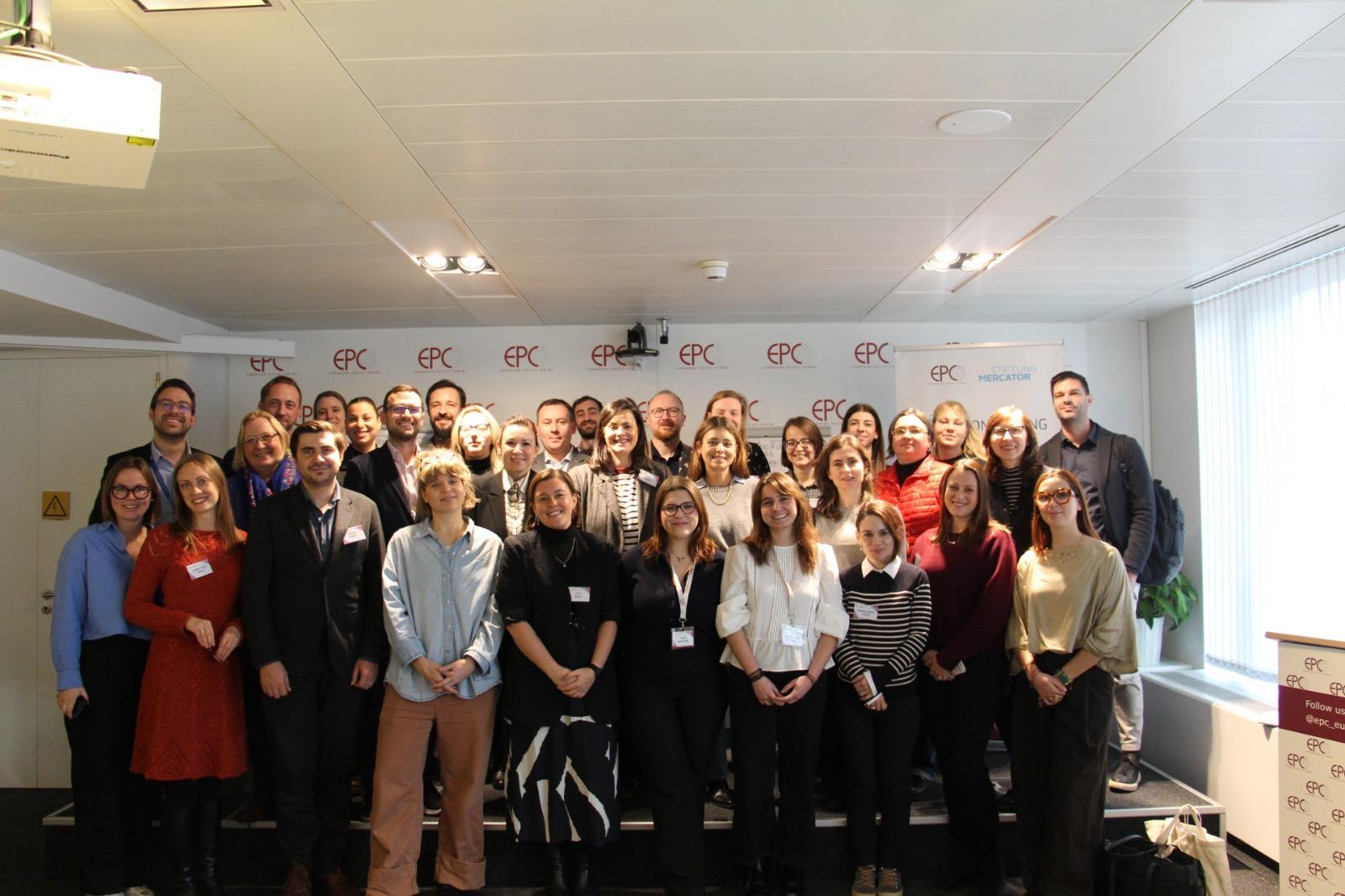 Thinking Enlarged Community Meeting, December 2025. PHOTO BY: EPC
Thinking Enlarged Recommendations 2026
Enlargement is increasingly inseparable from internal EU debates on democratic resilience, digital governance, competitiveness, the climate transition and Europe’s geopolitical positioning. Yet candidate-country civil society is still too often at the margins of these conversations, consulted on an ad hoc basis rather than embedded structurally. The absence of systematic consultation mechanisms within EU institutions, combined with weak linkages between candidate-country CSOs and wider EU policy networks beyond enlargement-dedicated avenues, leaves funding fragmented and access to decision-making limited.
This disconnect weakens both sides. It deprives the EU of expertise from regions already navigating democratic resilience under pressure and reinforces scepticism in enlargement countries about the EU’s willingness to treat them as future insiders.
Enlargement can no longer be siloed as a technical file handled by a narrow institutional circle. Framing enlargement exclusively as a DG ENEST issue risks detachment from the policy areas that will define membership readiness.
EU institutions must think enlarged – not as an outreach exercise, but as preparatory governance. Candidate countries must align not only with the acquis, but with the EU’s broader ambitions. The Community Meeting confirmed this need to think enlarged.
1. Safeguard civil society funding in the next MFF
As argued by Johannes Greubel, the European Parliament and Council must secure protected funding lines for civil society, including candidate-country organisations, within the next MFF, preserving allocations under AgoraEU and Global Europe.
The budget design must prioritise core institutional funding, cross-border cooperation instruments and rapid-response support for organisations under political pressure, recognising democracy and democratic institutions as strategic investment. The co-legislators should assess how the entire budget design affects civil society inclusion and embed smart conditionality to prevent political gatekeeping, as Eric Maurice writes in his contribution.
2. Anchor candidate countries earlier in EU policy ecosystems
In 2026, the Commission should accelerate structured inclusion of candidates in core policy mechanisms and toolboxes. This includes ensuring their CSOs are involved at different stages of drafting the Rule of Law Report (see contribution by Eric Maurice), extending the Justice Scoreboard to candidate countries (see contribution by ResilioAccess), and granting early access to selected Green Deal and competitiveness instruments (see contribution by Ana Berdzenishvili). The Democracy Shield and the EU Civil Society Strategy must be implemented equally in member states and candidate countries (see contribution by Giulia Torchio).
The Commission should also strengthen the independence of state institutions in candidate countries and enhance their capacity to monitor EU fund allocation. While CSOs play a watchdog role, they often compensate for weak state functions without adequate protection or institutional follow-up. Formal channels should ensure that CSO evidence feeds directly into monitoring, implementation and corrective mechanisms.
3. Strengthen cross-regional CSO coalitions
The Commission should reinforce structured cooperation between regional civil society platforms in the Western Balkans, Eastern Partnership and Türkiye, while sustaining engagement with EU-level mechanisms such as the EESC’s Enlargement Candidate Members initiative.
Regular, cross-regional cooperation should be established to enable CSOS to share expertise, coordinate advocacy and feed joint inputs on enlargement, foreign policy and MFF negotiations. Existing EU-level platforms should serve as entry points for systematic dialogue rather than ad hoc exchanges.
The need for a new narrative
If the EU is to meet its own accession timelines, it must move from strategy to delivery – starting with a renewed narrative on enlargement. Public communication cannot focus solely on the costs of enlargement but also articulate the strategic risks and costs of non-enlargement. Clear, consistent, fact-based yet emotionally resonant messaging is essential to prevent instrumentalisation by far-right and external actors.
Enlargement must be made tangible through ‘hearts and minds’ approaches that demystify candidate countries, counter reductive narratives and connect enlargement to everyday life and shared European identity.
Civil society – from EU member states and candidate countries – can act as a transmission belt, translating EU debates into domestic contexts. This role, however, requires structured engagement, sustainable funding and sustained political will from EU institutions and member states.
Johannes Greubel is Senior Policy Analyst, Head of Programme and ‘Connecting Europe’ Project Lead at the EPC.
Liza Saris is Policy Analyst and Project Manager at the EPC.
Vanna Curin is Programme Assistant at the EPC.
Talisa Mazzoni is Programme Assistant at the EPC.
The support the European Policy Centre receives for its ongoing operations, or specifically for its publications, does not constitute an endorsement of their contents, which reflect the views of the authors only. Supporters and partners cannot be held responsible for any use that may be made of the information contained therein.

Thinking Enlarged in 2026: Leveraging perspectives from future member states
Why in 2026, we must think enlarged
Over the past years, the European institutions have heralded a new momentum for EU enlargement, pledging that it is realistic for up to “two or three” new members to join during this mandate. But if the Union is serious about delivering on that ambition within the current cycle, 2026 must be the year when political rhetoric gives way to operational decisions – on funding, internal reforms and the legal preparations required for the next accession treaty.
And getting real about enlargement also requires ‘thinking enlarged’, which means embedding an enlargement dimension into current EU policy debates and involving civil society from candidate countries earlier and more systematically in the debates shaping EUrope’s future.
The Policy Brief Thinking Enlarged published last year explored the potential benefits for both the enlargement agenda and EU policymaking if this approach were integrated into the EU’s internal structures.
Systematically engaging tomorrow’s members in today’s discussions can strengthen reform momentum, regional buy-in and bottom-up trust in the process. At the same time, transregional EU policies on climate adaptation, digital governance, foreign policy and the rule of law stand to benefit from the expertise offered by candidate countries. In 2025, the Commission’s communication on the Democracy Shield and the Civil Society Strategy acknowledged that civic space is a continuum between the EU and candidate countries, and that many of the challenges faced are shared. Collaboration and cross-border networks are therefore essential for impactful policymaking, particularly in these areas.
With the Commission’s latest progress assessments and notable reform steps across candidate countries underway, the coming years will be decisive for setting priorities and securing support for the accession process. The European Policy Centre organised a Thinking Enlarged Community Meeting in December 2025 to identify realistic opportunities to strengthen the role of civil society in shaping policies on EUrope’s future in 2026, thereby advancing the enlargement process. It brought together CSOs from member states, the EU level and candidate countries to exchange views not only on enlargement, but on how it links to digital governance, foreign policy, climate adaptation and rule of law reporting.
This compendium collects the reflections and recommendations that emerged from these conversations. It serves as a tool for coalition-building, messaging alignment and agenda-setting for 2026.
Read the full compendium here.
Thinking Enlarged Recommendations 2026
Enlargement is increasingly inseparable from internal EU debates on democratic resilience, digital governance, competitiveness, the climate transition and Europe’s geopolitical positioning. Yet candidate-country civil society is still too often at the margins of these conversations, consulted on an ad hoc basis rather than embedded structurally. The absence of systematic consultation mechanisms within EU institutions, combined with weak linkages between candidate-country CSOs and wider EU policy networks beyond enlargement-dedicated avenues, leaves funding fragmented and access to decision-making limited.
This disconnect weakens both sides. It deprives the EU of expertise from regions already navigating democratic resilience under pressure and reinforces scepticism in enlargement countries about the EU’s willingness to treat them as future insiders.
Enlargement can no longer be siloed as a technical file handled by a narrow institutional circle. Framing enlargement exclusively as a DG ENEST issue risks detachment from the policy areas that will define membership readiness.
EU institutions must think enlarged – not as an outreach exercise, but as preparatory governance. Candidate countries must align not only with the acquis, but with the EU’s broader ambitions. The Community Meeting confirmed this need to think enlarged.
1. Safeguard civil society funding in the next MFF
As argued by Johannes Greubel, the European Parliament and Council must secure protected funding lines for civil society, including candidate-country organisations, within the next MFF, preserving allocations under AgoraEU and Global Europe.
The budget design must prioritise core institutional funding, cross-border cooperation instruments and rapid-response support for organisations under political pressure, recognising democracy and democratic institutions as strategic investment. The co-legislators should assess how the entire budget design affects civil society inclusion and embed smart conditionality to prevent political gatekeeping, as Eric Maurice writes in his contribution.
2. Anchor candidate countries earlier in EU policy ecosystems
In 2026, the Commission should accelerate structured inclusion of candidates in core policy mechanisms and toolboxes. This includes ensuring their CSOs are involved at different stages of drafting the Rule of Law Report (see contribution by Eric Maurice), extending the Justice Scoreboard to candidate countries (see contribution by ResilioAccess), and granting early access to selected Green Deal and competitiveness instruments (see contribution by Ana Berdzenishvili). The Democracy Shield and the EU Civil Society Strategy must be implemented equally in member states and candidate countries (see contribution by Giulia Torchio).
The Commission should also strengthen the independence of state institutions in candidate countries and enhance their capacity to monitor EU fund allocation. While CSOs play a watchdog role, they often compensate for weak state functions without adequate protection or institutional follow-up. Formal channels should ensure that CSO evidence feeds directly into monitoring, implementation and corrective mechanisms.
3. Strengthen cross-regional CSO coalitions
The Commission should reinforce structured cooperation between regional civil society platforms in the Western Balkans, Eastern Partnership and Türkiye, while sustaining engagement with EU-level mechanisms such as the EESC’s Enlargement Candidate Members initiative.
Regular, cross-regional cooperation should be established to enable CSOS to share expertise, coordinate advocacy and feed joint inputs on enlargement, foreign policy and MFF negotiations. Existing EU-level platforms should serve as entry points for systematic dialogue rather than ad hoc exchanges.
The need for a new narrative
If the EU is to meet its own accession timelines, it must move from strategy to delivery – starting with a renewed narrative on enlargement. Public communication cannot focus solely on the costs of enlargement but also articulate the strategic risks and costs of non-enlargement. Clear, consistent, fact-based yet emotionally resonant messaging is essential to prevent instrumentalisation by far-right and external actors.
Enlargement must be made tangible through ‘hearts and minds’ approaches that demystify candidate countries, counter reductive narratives and connect enlargement to everyday life and shared European identity.
Civil society – from EU member states and candidate countries – can act as a transmission belt, translating EU debates into domestic contexts. This role, however, requires structured engagement, sustainable funding and sustained political will from EU institutions and member states.
Johannes Greubel is Senior Policy Analyst, Head of Programme and ‘Connecting Europe’ Project Lead at the EPC.
Liza Saris is Policy Analyst and Project Manager at the EPC.
Vanna Curin is Programme Assistant at the EPC.
Talisa Mazzoni is Programme Assistant at the EPC.
The support the European Policy Centre receives for its ongoing operations, or specifically for its publications, does not constitute an endorsement of their contents, which reflect the views of the authors only. Supporters and partners cannot be held responsible for any use that may be made of the information contained therein.
Share link:
Related Post
The proliferation of AI-enabled military technology in the Middle East
From drones to rocket fuel, China and Russia are helping Iran through supply chains
Defending the skies of the Arab Gulf states