Strategic Evolution, Operational Patterns, and Implications for Modern Warfare
European Institute for Peace and Governance (EIPG)
Unmanned aerial vehicles (UAVs) have become a defining feature of modern warfare, and the ongoing war involving Iran represents one of the most significant demonstrations of large-scale drone warfare in the twenty-first century. The conflict has highlighted the growing importance of low-cost autonomous weapons systems capable of conducting surveillance, precision strikes, and mass saturation attacks against advanced air defense systems.
This research examines the role of drones in the Iran war, focusing on the types of systems deployed, the operational strategies behind their use, and the broader implications for global military doctrine. Evidence suggests that drones have become central to Iran’s asymmetric warfare strategy, enabling Tehran to project power across the region while compensating for limitations in its conventional air force.
The paper argues that the Iran war may represent a turning point in military history, demonstrating how relatively inexpensive unmanned systems can challenge advanced military defenses and reshape the future of conflict.
1. Introduction: The Drone War Era
The increasing use of drones in military conflict reflects a broader transformation in warfare. Over the past two decades, unmanned aerial vehicles have evolved from reconnaissance tools into sophisticated weapons capable of conducting autonomous attacks.
The Iran war represents one of the most significant examples of this transformation. Both state actors and allied militias have relied heavily on drones to conduct surveillance, strike strategic targets, and overwhelm enemy defenses.
Recent reports indicate that Iran has deployed large waves of drones across the region, targeting military installations, energy infrastructure, and strategic facilities in multiple countries.
These developments illustrate a key shift in military strategy: rather than relying exclusively on high-cost fighter aircraft or ballistic missiles, states increasingly deploy large numbers of relatively inexpensive drones capable of saturating enemy defenses.
2. Iran’s Drone Strategy
Iran has invested heavily in unmanned aerial technology over the past two decades. This investment reflects both strategic necessity and technological adaptation.
Due to international sanctions and the aging condition of its conventional air force, Iran has prioritized missile and drone development as alternative tools of military power projection.
Drone warfare offers several advantages for Iranian military planners:
Cost efficiency – drones are far cheaper than traditional aircraft.
Operational flexibility – they can conduct surveillance, strike operations, or electronic warfare missions.
Strategic ambiguity – drones can be launched remotely or via proxy forces, complicating attribution.
These advantages have allowed Iran to develop one of the most extensive drone programs in the Middle East.
3. Types of Iranian Drones Used in the Conflict
Several types of drones have been reported in connection with the Iran war. These include both reconnaissance drones and so-called “loitering munitions” designed to explode on impact.
Shahed-136 Kamikaze Drone
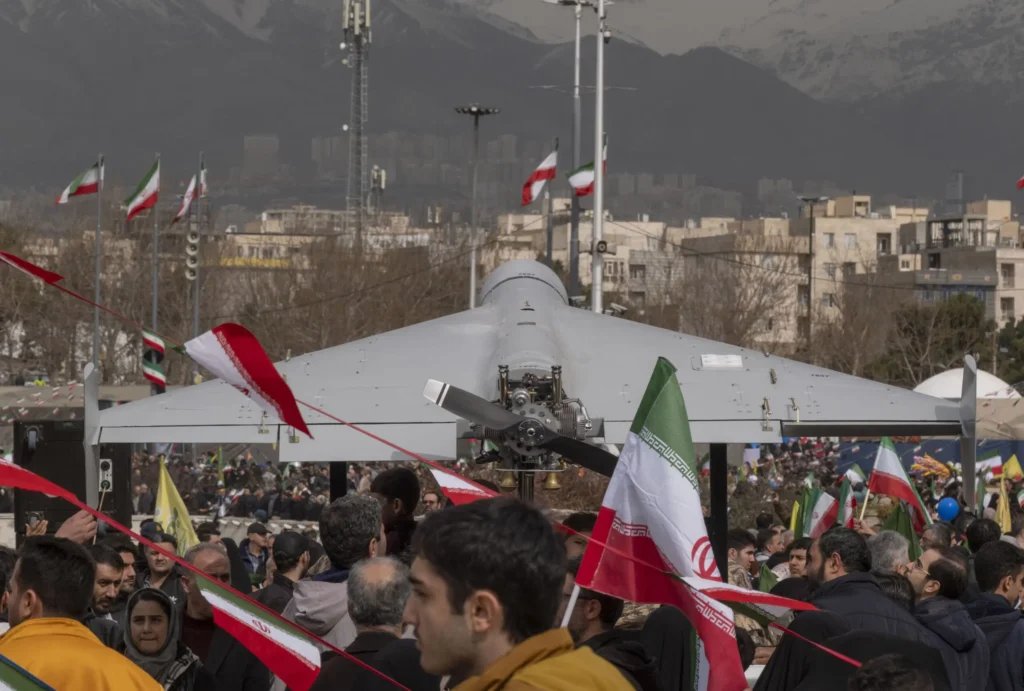
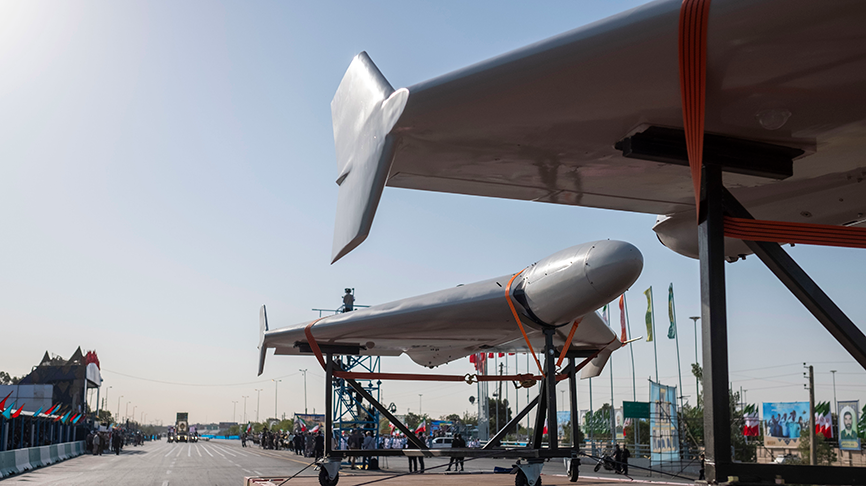
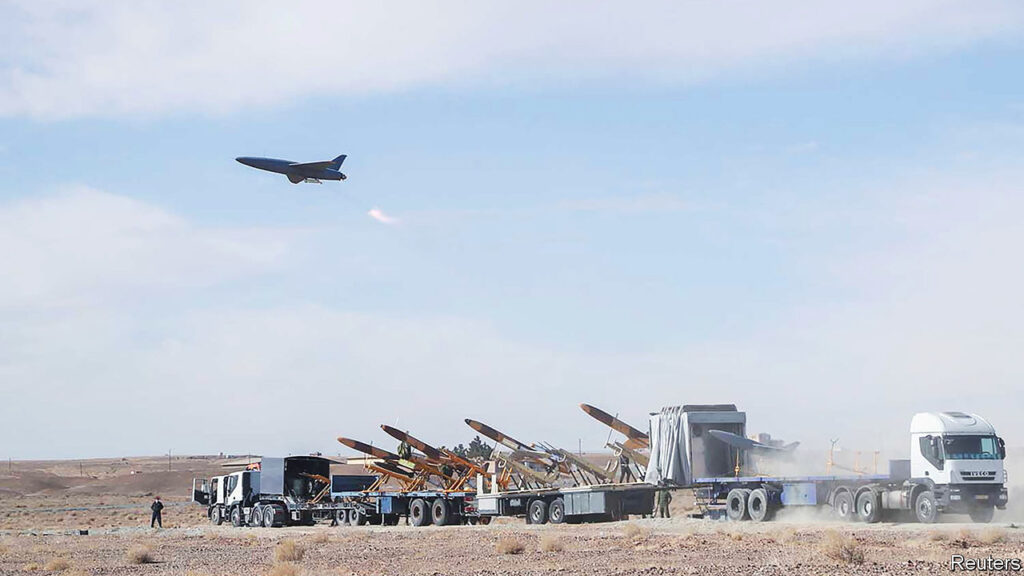
One of the most widely known systems is the Shahed-136, a loitering munition often described as a “kamikaze drone.” These drones are designed to fly toward a pre-programmed target and detonate upon impact.
The system’s relatively simple design allows for mass production, making it particularly effective in saturation attacks.
Shahed-129 Combat UAV
The Shahed-129 is a larger armed drone capable of carrying guided missiles and conducting surveillance operations. It can remain airborne for long durations and strike ground targets with precision munitions.
Shahed-149 “Gaza”
Another advanced system is the Shahed-149, a long-endurance drone comparable in size and role to Western drones such as the MQ-9 Reaper. It can operate for up to 24 hours and has a range of approximately 2,500 kilometers.
Together, these systems form the backbone of Iran’s expanding unmanned aerial fleet.
4. Scale of Drone Operations
Drone attacks have played a major role in the escalation of the Iran war. In several waves of conflict, Iran reportedly launched hundreds or even thousands of drones alongside missile strikes.
More recent reporting suggests that Iran has used mass drone launches against Gulf states, targeting airports, ports, and military bases.
In some cases, the attacks involved coordinated drone and missile strikes designed to overwhelm air defense systems.
The scale of these operations illustrates the increasing militarization of drone technology.
5. Drone Swarm Tactics
One of the most significant developments in the Iran war is the use of swarm tactics.
Rather than deploying a small number of high-value drones, military planners launch dozens or hundreds of drones simultaneously.
The objective is to saturate defensive systems.
Air defense networks such as Patriot or Iron Dome are designed to intercept missiles and aircraft, but defending against large numbers of low-cost drones presents a unique challenge.
By overwhelming defensive systems with sheer numbers, attackers can increase the probability that at least some drones reach their targets.
6. Regional Impact
Drone warfare in the Iran war has had significant regional consequences.
Several countries in the Middle East have experienced drone attacks targeting critical infrastructure, including:
- military bases
- airports
- ports
- energy facilities
Recent incidents have demonstrated how drone warfare can expand conflict beyond the primary battlefield.
For example, Iranian drone strikes were reported against regional infrastructure in the South Caucasus, highlighting the conflict’s potential to spill into neighboring regions.
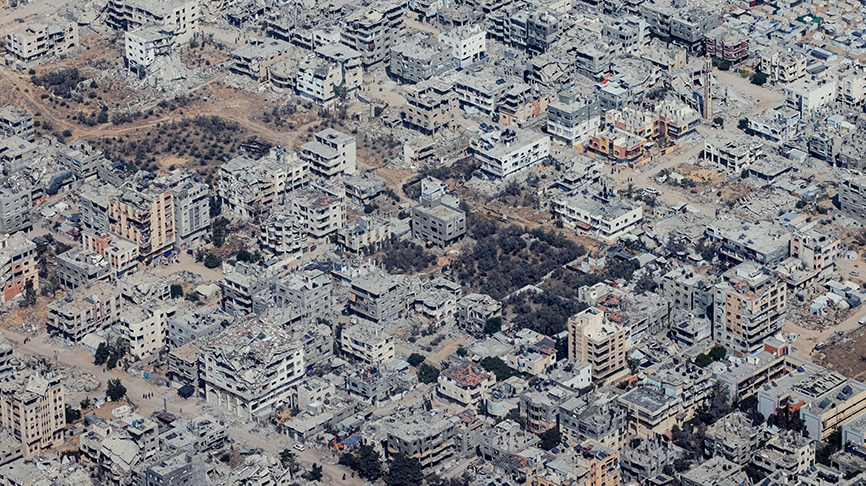
Such attacks raise concerns about the vulnerability of civilian infrastructure to unmanned weapons systems.
7. Challenges for Air Defense Systems
The Iran war has exposed several weaknesses in existing air defense systems.
Traditional air defense networks are optimized to intercept:
- fighter aircraft
- ballistic missiles
- cruise missiles
However, small drones present a different type of threat.
They typically:
- fly at low altitude
- produce limited radar signatures
- move at relatively slow speeds
These characteristics make them difficult to detect and intercept.
Additionally, drones are often deployed in large numbers, forcing defenders to expend expensive interceptor missiles against low-cost aerial targets.
8. The Economics of Drone Warfare
One of the most striking aspects of drone warfare is its economic asymmetry.
A typical loitering munition may cost only a few tens of thousands of dollars.
By contrast, interceptor missiles used to destroy drones may cost hundreds of thousands or even millions of dollars.
This cost imbalance allows attackers to impose significant financial strain on defensive systems.
Drone warfare therefore represents a strategic shift toward economically asymmetric conflict.
9. Future Implications
The widespread use of drones in the Iran war has several implications for the future of global warfare.
Proliferation
Drone technology is relatively easy to manufacture and export. As a result, many states and non-state actors are likely to develop similar capabilities.
Autonomous weapons
Advances in artificial intelligence may allow drones to operate with increasing levels of autonomy.
Defense innovation
The growing drone threat is likely to accelerate investment in new counter-drone technologies, including:
- laser weapons
- electronic warfare systems
- AI-based detection systems
Conclusion
The Iran war illustrates the rapid transformation of modern warfare. Drones have emerged as one of the most significant military technologies of the twenty-first century, enabling states to conduct large-scale attacks at relatively low cost.
Iran’s drone strategy demonstrates how unmanned systems can compensate for weaknesses in conventional air power while expanding a state’s ability to project force across regional theaters.
As drone technology continues to evolve, its role in military conflict is likely to expand even further. The lessons of the Iran war may therefore shape military doctrine, defense planning, and international security for decades to come.