International cooperation can take various forms. At the more formal end, organizations are established and endowed with budgets, staffs, and buildings from which to carry out their work. On the other extreme, cooperation on narrower topics may involve a treaty negotiated once with little follow-up work. But work in many important areas, including climate change, sits somewhere in the middle: a treaty is signed, and the parties to the treaty hold regular meetings for continuing work.
The United Nations Framework Convention on Climate Change (UNFCCC), like the G20 and many similar arrangements, has a small secretariat, but the bulk of the political work is the remit of the rotating presidency. As a rule, this presidency has been held by the country hosting and leading that year’s Conference of the Parties (COP). But in 2026, this arrangement will change, and the impact on the substance of negotiations is yet to be seen.
Breaking the Impasse
The 30th Conference of the Parties (COP30) was held in Belém, Brazil, in 2025 under Brazil’s presidency. UNFCCC rules distinguish between the roles of COP host and COP president, though they are generally held by the same country. The host provides the venue and associated logistical services; the president leads the negotiations, ensures observance of procedural rules, and seeks consensus among the parties. While the president is expected to separate their leadership role from their national position and operate impartially, they are also expected to seek ambitious climate outcomes. Both roles are selected on a rotating basis by each of the five UN regional groups: the African Group, the Asia-Pacific Group, the Eastern European Group, the Latin American and Caribbean Group, and the Western European and Others Group (WEOG).
COP31 was WEOG’s turn. This heterogenous group, including Western European states, Australia, Canada, Israel, New Zealand, Türkiye, and the United States, had to make a unanimous decision. This proved difficult when two countries announced their candidacies: Australia and Türkiye. Hosting decisions are typically made two years in advance, but there was no agreement in sight at 2024’s COP29, nor at the midyear meeting of the UNFCCC subsidiary bodies the following summer.
As the impasse extended, frustration grew—particularly with Türkiye. Much of the climate community considered Australia the more natural choice given that it has pursued a more ambitious climate policy in recent years and pledged to work closely with the 14 Pacific small island developing states (SIDS): the Cook Islands, Fiji, Kiribati, the Marshall Islands, Micronesia, Nauru, Niue, Palau, Papua New Guinea, Samoa, the Solomon Islands, Tonga, Tuvalu, and Vanuatu. These are among the world’s smallest states and among the most vulnerable to the adverse impacts of climate change. Since many of the Pacific SIDS lack the capacity to host such a conference, an Australian presidency was seen as a symbolic way to center their priorities. By one count, Australia’s bid was supported by 23 of 28 WEOG members. Some actors saw Türkiye’s persistence as an attempt to build prestige through hosting a major conference, while others thought it was only seeking to gain leverage to trade hosting rights for something else. In 2021, the UK had convinced Türkiye to agree to a Glasgow COP by offering the country an investment conference and support of Turkish candidates for prominent international roles.
If the parties could not reach agreement, the COP would be held at the UNFCCC’s headquarters in Bonn, Germany. Most parties, including Germany, wanted to avoid this option, because it would signal disunity and make the summit feel like a lower-level subsidiary body meeting.
Technically, a presidency begins at the start of its COP and extends to the beginning of the next one. In practice, however, the bulk of the work is in the lead-up to their summit and concludes at its close. Like other rotating-presidency regimes, a “troika” of the previous, current, and incoming presidents cooperate to ensure a smooth transition and set goals beyond the calendar year. Even with over a year to go, the lack of clarity was already impacting the orderly relay of work between presidencies.
By the time countries assembled at COP30, it seemed clear that Türkiye’s President Recep Tayyip Erdoğan was serious about hosting, and behind the scenes, Australia seemed ready to make a deal. Having ruled out co-hosting earlier in the summit’s second week, Australia seemed to be softening its position, stating it would not block Türkiye while still not formally stepping aside. Prime Minister Anthony Albanese explained his concern that discord could lower ambition and harm vulnerable countries, including the Pacific SIDs.
An Unconventional Compromise
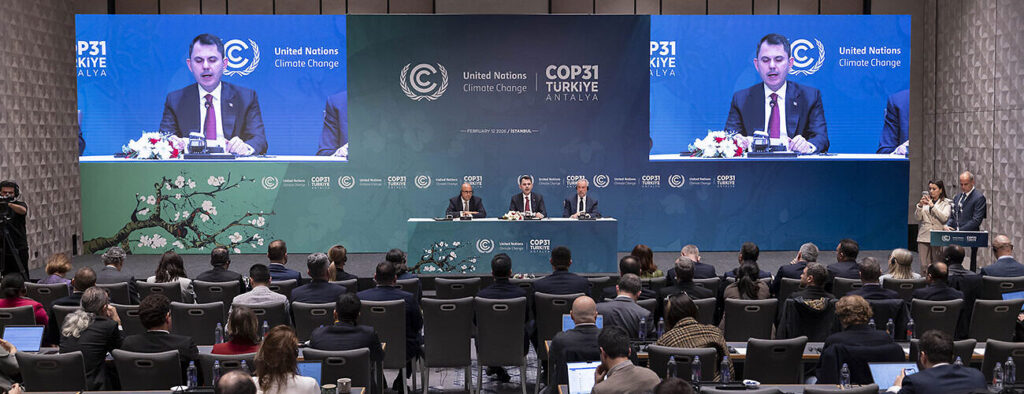
Eventually, a deal was announced: Türkiye will both preside over and host COP31, undertaking the vast majority of legal and logistical responsibilities, including hosting the leaders’ summit, ensuring the rules of the summit are followed, and signing the host-country agreement with the UNFCCC. The summit will be held November 9th–20th in the Mediterranean coastal city of Antalya.
Australia will assume a newly created role as “president of negotiations,” defined as holding “exclusive authority” in the negotiation process. In the lead-up to the summit, Australia will serve as the lead on all mandates from negotiated outcomes, convene consultations, and manage communications. Most importantly, Australia will select ministerial pairs and other co-facilitators and lead negotiations throughout COP31, including drafting and finalizing texts. The pre-COP meeting will be hosted by Australia in a Pacific state to highlight issues relevant to the region. On February 26th, Australian Minister for Climate Change and Energy Chris Bowen announced that Fiji had been selected as the primary host, with an associated leaders component in Tuvalu and a special climate event in Palau just before during the Pacific Islands Forum. Australia will also be one of the seven COP vice presidents. Türkiye will name the UN high-level climate champion and oversee the action agenda, while Australia will choose the youth champion. Both countries pledged to consult closely, agreeing that “if there is a difference of views between Türkiye and Australia, consultations will take place until the difference is resolved to mutual satisfaction.”
This arrangement is novel in several ways. Splitting the hosting and presidency roles of a major international conference is rare: Fiji was named president of COP23 in 2017, the first time for any SIDS country, but the conference was held in Bonn due to capacity constraints. Two years later, COP25 was presided over by Chile in 2019 but relocated to Madrid after the outbreak of widespread protests. In earlier COPs, summits were occasionally held in major European diplomatic centers under presidencies from other countries. Nevertheless, such arrangements have been rare, both in the UNFCCC and in other similar treaty systems.
COP31 will be unique in other ways as well. The creation of a “president of negotiations” is unheard of. Equally significant is the elevation of the Pacific SIDs’ priorities despite these countries neither hosting nor holding the presidency. Critical questions also remain unanswered, including how differences between Türkiye and Australia will be resolved, whether Türkiye will have the final word, and what role Australia will play for the 50 weeks of Türkiye’s presidency after COP31 concludes.
Risks and Opportunities
Amidst the uncertainty, there are both risks and opportunities, and both presiding countries must work to ensure an optimal outcome.
One risk concerns multilateral norms. Türkiye secured the presidency by not stepping aside, despite broad support for Australia. Türkiye’s actions may inspire future candidates to hold decision making hostage in the hopes of securing private benefits—a strategy that undermines efficiency and international solidarity. Equally problematic is the risk of institutional confusion: ambiguity over leadership roles could lead to gridlock or dilute ambition, particularly if neither country feels full ownership over the process to push for stronger outcomes. Finally, having to deal with two key countries rather than one may be an additional burden on participants, particularly developing countries with limited resources.
However, there are also opportunities. If the shared leadership model proves effective, Türkiye and Australia may show that cooperation can work, especially if they are seen to work well together in the lead-up to and throughout the conference. Shepherding nearly 200 parties and countless other stakeholders toward agreement is not only a political challenge; it is also a massive logistical undertaking. If separating these roles allows each team to focus more fully on its responsibilities, it could enhance both the process and the outcome.
The biggest opportunity may lie in expanding possibilities for countries like the Pacific SIDs that are too small or vulnerable to physically host the COP to still take on a formal leadership role. If this model proves workable, it could provide these countries with an additional and powerful platform to elevate their voices.