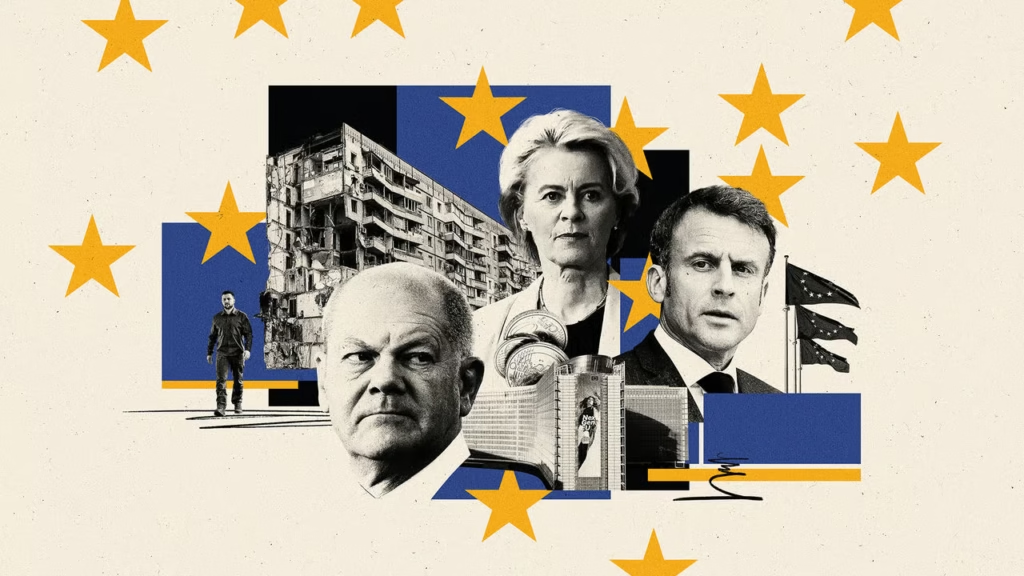
The rise of China, Russia’s military aggression, technological competition, energy insecurity, political polarization, migration crises, and weakening trust in democratic institutions are all reshaping the strategic environment confronting Europe and the United States.
The European Institute for Peace and Governance (EIPG)
The transatlantic alliance between Europe and the United States has served as the foundation of Western political, military, and economic power since the end of the Second World War. NATO, shared democratic values, economic integration, and coordinated foreign policy enabled the Western alliance to dominate the international system for decades.
However, the global order is undergoing profound transformation. The rise of China, Russia’s military aggression, technological competition, energy insecurity, political polarization, migration crises, and weakening trust in democratic institutions are all reshaping the strategic environment confronting Europe and the United States.
At the same time, internal tensions within the alliance itself are becoming increasingly visible.
Questions that once appeared unthinkable are now openly debated across Europe and Washington: Can Europe continue relying on American security guarantees? Will future U.S. administrations remain committed to NATO? Can the West maintain unity against Russia and China? Is the liberal international order entering a period of irreversible decline?
These questions are no longer theoretical.
Russia’s invasion of Ukraine exposed both the strength and fragility of the Western alliance. While NATO regained strategic relevance and unity in response to Moscow’s aggression, the war also highlighted Europe’s dependence on American military capabilities, intelligence systems, and strategic leadership.
Meanwhile, China’s growing economic and technological influence is creating new divisions between Europe and the United States regarding trade, industrial policy, artificial intelligence, semiconductors, and critical supply chains.
The transatlantic alliance therefore stands at a historic crossroads.
The future of Western power may ultimately depend on whether Europe and the United States can adapt together to an increasingly fragmented and competitive world order.
The Historical Foundations of the Transatlantic Alliance
The transatlantic partnership emerged from the geopolitical devastation of World War II.
The United States played a central role in rebuilding Western Europe through the Marshall Plan, NATO, and broader security guarantees designed to contain Soviet expansion during the Cold War.
For decades, NATO served not only as a military alliance but also as a political framework connecting North America and Europe within a shared strategic system.
The collapse of the Soviet Union appeared to cement Western dominance globally. Liberal democracy, free markets, and globalization expanded rapidly during the 1990s and early 2000s.
However, the post-Cold War optimism gradually faded.
Military interventions in Iraq and Afghanistan, the global financial crisis, rising populism, migration pressures, Brexit, and increasing geopolitical rivalry exposed growing fractures within the Western alliance.
The era of uncontested Western dominance began to weaken.
Russia’s War in Ukraine and the Return of Geopolitical Conflict
Russia’s invasion of Ukraine fundamentally transformed European security calculations.
The war shattered long-standing assumptions that economic interdependence would prevent large-scale war in Europe. It also revived NATO’s strategic importance after years of internal uncertainty.
The United States rapidly emerged as the primary military and financial supporter of Ukraine, providing advanced weapons systems, intelligence sharing, training, and strategic coordination.
European countries also increased defense spending dramatically and expanded military cooperation.
However, the war exposed major structural weaknesses inside Europe, including limited ammunition production, fragmented defense industries, and dependence on American military capabilities.
At the same time, the conflict intensified broader geopolitical competition between democratic and authoritarian systems globally.
The war in Ukraine is therefore not only a regional conflict, but also part of a wider struggle over the future international order.
Strategic Autonomy and Europe’s Dilemma
One of Europe’s most important strategic debates today concerns the concept of “strategic autonomy.”
European leaders increasingly recognize the risks of excessive dependence on the United States for defense, technology, energy, and industrial supply chains.
French President Emmanuel Macron has repeatedly argued that Europe must become more geopolitically independent and capable of defending its own strategic interests.
Supporters of strategic autonomy believe Europe should strengthen defense integration, increase industrial resilience, develop independent technological infrastructure, and reduce vulnerabilities to external powers.
However, European countries remain divided regarding the extent of autonomy Europe should pursue.
Eastern European states, particularly Poland and the Baltic countries, continue prioritizing close military cooperation with Washington due to fears of Russian aggression.
For many European governments, American military protection remains irreplaceable.
This creates a strategic paradox: Europe seeks greater independence while simultaneously relying heavily on the United States for security.
China and the Transatlantic Divide
China represents one of the most complex challenges confronting the transatlantic alliance.
Washington increasingly views Beijing as its primary long-term geopolitical competitor and has adopted a strategy focused on technological containment, industrial competition, and supply chain restructuring.
Europe shares many American concerns regarding China’s technological influence, human rights practices, cyber capabilities, and strategic investments.
However, European economies remain deeply interconnected with Chinese markets and manufacturing systems.
Many European governments seek to avoid full-scale economic confrontation with Beijing, preferring a more balanced approach combining competition, cooperation, and selective risk reduction.
This divergence creates tensions within the Western alliance regarding trade policy, semiconductor restrictions, industrial subsidies, and technological decoupling.
Managing relations with China may become one of the most difficult tests of transatlantic unity during the coming decade.
Technology Competition and Digital Sovereignty
Technology is becoming central to geopolitical competition between major powers.
Artificial intelligence, semiconductors, cybersecurity, quantum computing, cloud infrastructure, and critical digital systems increasingly shape economic and military power.
The United States currently dominates many advanced technology sectors through companies such as Microsoft, Google, NVIDIA, OpenAI, Amazon, and others.
At the same time, Europe fears excessive technological dependence on both American and Chinese companies.
The European Union increasingly promotes “digital sovereignty” through stricter regulation, data protection laws, AI governance frameworks, and investment in domestic technological capabilities.
However, Europe faces challenges competing with the scale of American and Chinese technology ecosystems.
The future of Western technological leadership may depend on whether Europe and the United States can coordinate effectively on innovation, regulation, and industrial policy.
Economic Pressures and Industrial Competition
Economic tensions are also emerging within the transatlantic relationship.
American industrial policies, particularly subsidies targeting green technologies and semiconductor manufacturing, have raised concerns in Europe regarding unfair competition and industrial relocation.
European leaders worry that aggressive American subsidies may attract investment away from European industries.
At the same time, both sides recognize the need to reduce dependence on Chinese supply chains and strengthen domestic manufacturing capacity.
Balancing economic competition with strategic cooperation has therefore become increasingly difficult.
The future of Western economic coordination may depend on developing shared industrial strategies capable of competing globally without undermining internal alliance cohesion.
Migration, Populism, and Political Polarization
Domestic political instability increasingly affects the strength of the transatlantic alliance.
Migration pressures, inflation, housing crises, social inequality, and cultural polarization have fueled the rise of nationalist and populist movements across Europe and the United States.
Far-right parties questioning globalization, immigration, NATO commitments, and European integration continue gaining political influence.
Political polarization in the United States also creates uncertainty regarding future foreign policy continuity.
European governments increasingly fear scenarios in which future American administrations reduce military commitments to Europe or adopt more isolationist policies.
Internal democratic instability may therefore become one of the greatest long-term risks facing the Western alliance.
Energy Security and the New Geopolitics of Energy
The war in Ukraine transformed energy into a central strategic issue for Europe.
For decades, Europe relied heavily on Russian gas imports. The conflict forced European governments to rapidly diversify energy sources, expand LNG infrastructure, and accelerate renewable energy investment.
The United States emerged as a major supplier of liquefied natural gas to Europe, strengthening transatlantic energy ties.
At the same time, the global transition toward renewable energy is creating new geopolitical competition involving critical minerals, batteries, semiconductors, and green technologies.
Energy security is now deeply interconnected with technological competition and industrial policy.
NATO and the Future of Western Security
Despite internal tensions, NATO remains the core institution of Western military power.
The alliance expanded significantly after Russia’s invasion of Ukraine, with Finland joining NATO and Sweden moving toward deeper integration.
European defense spending has increased substantially, reversing decades of military underinvestment.
However, NATO’s future still depends heavily on American leadership and military capabilities.
The key long-term question is whether Europe can eventually assume greater responsibility for continental defense while preserving alliance unity.
If successful, this could strengthen NATO by creating a more balanced partnership.
If unsuccessful, internal dependence and political tensions may deepen over time.
The Decline of the Liberal International Order
The transatlantic alliance also faces a broader systemic challenge: the weakening of the liberal international order itself.
The post-Cold War era was built around assumptions of globalization, democratic expansion, economic integration, and Western leadership.
Today, that order faces pressure from authoritarian powers, geopolitical fragmentation, protectionism, technological rivalry, and declining trust in international institutions.
Russia and China increasingly challenge Western narratives regarding democracy, human rights, and global governance.
At the same time, internal crises within Western democracies weaken the credibility of liberal leadership internationally.
The future of the transatlantic alliance is therefore inseparable from the future of the global order itself.
Trump, Xi, and the Future of Western Strategy
Recent diplomatic developments further highlight the fragility of global strategic competition. During U.S. President Donald Trump’s recent visit to Beijing, discussions with Chinese President Xi Jinping underscored deep tensions surrounding Taiwan, trade, and global influence. Analysts noted that while Washington avoided major concessions on Taiwan, the broader summit revealed the limits of unilateral American bargaining with China and reinforced the importance of rebuilding coordination with allies and partners.
This dynamic carries important implications for Europe.
As strategic competition between Washington and Beijing intensifies, European governments may increasingly face pressure to align more closely with U.S. policies regarding China, semiconductors, supply chains, and critical technologies.
At the same time, Europe will continue attempting to preserve economic relations with China while defending its own strategic interests.
This balancing act may become one of the defining geopolitical challenges shaping the transatlantic alliance in the coming years.
The transatlantic alliance is entering a new and uncertain era.
Global instability, technological competition, war in Europe, energy insecurity, migration pressures, and political polarization are transforming the strategic foundations of Western power.
The alliance between Europe and the United States remains extraordinarily powerful, but it is no longer operating within the uncontested geopolitical environment that existed after the Cold War.
Europe increasingly seeks greater strategic autonomy while continuing to rely heavily on American military and technological leadership.
At the same time, the United States faces growing internal polarization and intensifying global competition with China.
The future strength of the transatlantic relationship will likely depend on whether both sides can adapt together to a more fragmented and competitive international order.
If Europe and the United States successfully coordinate their military, technological, industrial, and geopolitical strategies, the Western alliance may remain the dominant force shaping global politics during the twenty-first century.
If internal divisions deepen, however, the international balance of power may shift toward a far more unstable and multipolar world.