International reports suggest that Qatar has played an undeclared role in supporting the Sudanese army and allied Islamist factions by facilitating the transfer of weapons and drones to Port Sudan in coordination with Iran. Analysts view this as part of a broader proxy conflict, particularly after Abdel Fattah al-Burhan rejected international ceasefire efforts and instead proposed Qatari-Turkish mediation — raising Western concerns over prolonging the war and strengthening Islamist influence within Sudan’s military and political landscape.
The European Institute for Peace and Governance (EIPG)
While much of the world’s attention remains focused on the outcome of US-Iran negotiations aimed at preventing another Middle East war, another forgotten — yet closely connected — conflict continues to unfold in East Africa, where the war in Sudan rages on with no political solution in sight.
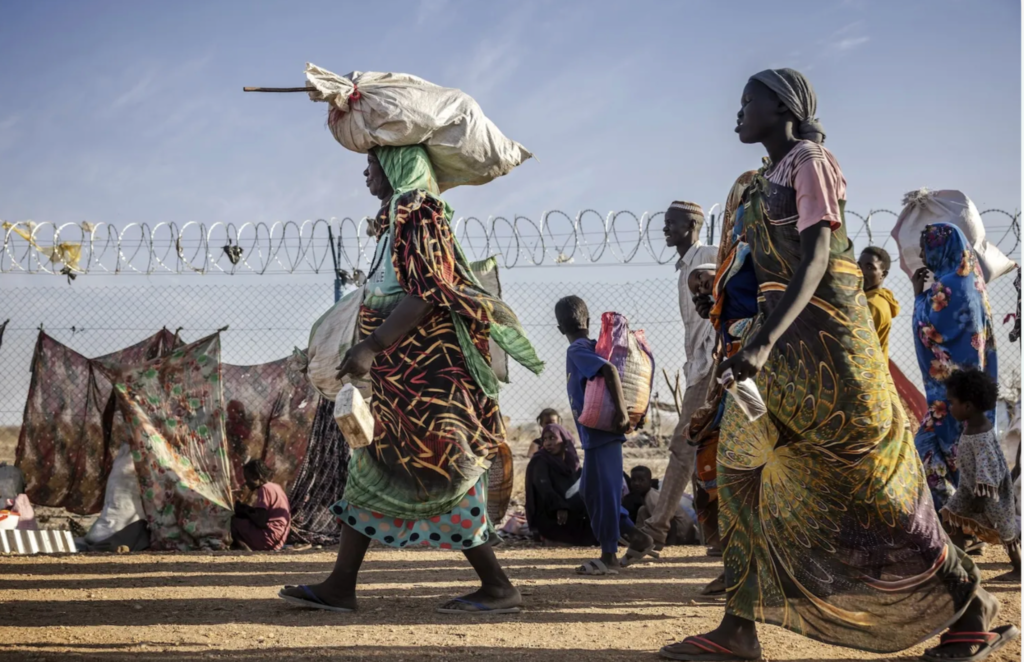
According to a report published in late April by the Institute for Peace and Diplomacy, “the war has forced four million Sudanese to flee the country, displaced millions more internally, and plunged several regions into prolonged hunger and famine.” However, the report warns that “the most dangerous aspect of the conflict is the growing involvement of foreign powers.”
The institute urged the international community not to focus solely on tensions with Iran while neglecting Sudan, stressing that regional and international actors must find a way to manage their rivalries in order to prevent the war from expanding beyond Sudan’s borders.
These concerns echoed an earlier warning issued by the European Parliament in December, which accused regional and international actors of fueling the Sudanese conflict. The statement specifically pointed to Qatar and Iran for allegedly supporting the Sudanese army, led by Abdel Fattah al-Burhan, in acts of systematic violence and killings against civilians.
The European Parliament stated that “information collected over several months indicates direct foreign interventions that have contributed to prolonging the war and deepening the humanitarian catastrophe,” describing this as “a blatant violation of international law that has further worsened the suffering of the Sudanese people.”
The parliamentary initiative also called for “an independent international investigation under United Nations supervision to determine the scale of involvement by the accused governments,” while demanding sanctions against individuals and entities proven to have supported or financed military operations targeting civilians.
But do foreign interventions in Sudan stop there?
A growing number of reports portray Qatar as a central example of external involvement in Sudan’s internal affairs through its support for the Sudanese army and its Islamist allies. These reports point to ongoing efforts aimed at protecting figures linked to Sudan’s former Islamist regime, alongside allegations of covert military assistance.
So how exactly is this support being carried out?
Bashir’s Trial in Qatar
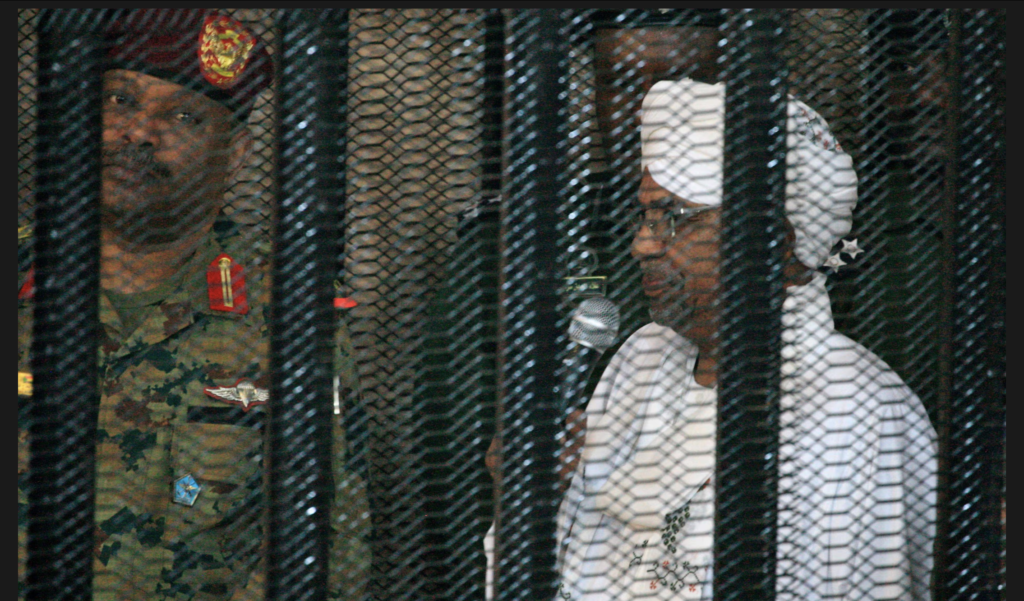
Although Sudanese army commander Abdel Fattah al-Burhan announced in 2019 that ousted president Omar al-Bashir would not be handed over to the International Criminal Court (ICC) — which accuses him of war crimes, crimes against humanity, and ethnic cleansing — reports have emerged in recent weeks suggesting that Bashir’s trial could instead be transferred to Qatar.
In March, The Sudan Times reported that “a senior adviser to Sudanese army commander General Abdel Fattah al-Burhan — the country’s de facto ruler since the military coup against the civilian government in October 2023 — proposed trying former Sudanese dictator Omar al-Bashir in Qatar, in a move that could reshape long-standing efforts to prosecute ICC suspects.”
The proposal raises fundamental questions, including whether Sudanese and Qatari authorities are attempting to conceal concerns linked to Qatar’s well-known role in supporting Islamist groups.
At the time, Salma Nour, a member of the Sudanese Professionals Association and the Forces of Freedom and Change, said that Burhan’s political adviser, Amjad Farid El Tayeb, had presented the proposal during contacts with the ICC in The Hague.
According to Nour, “the proposal is essentially based on a Qatari plan under which Bashir would be tried in Doha, with the possibility of serving any sentence there if convicted.” She added that “the ICC has issued neither confirmation nor denial regarding the matter.”
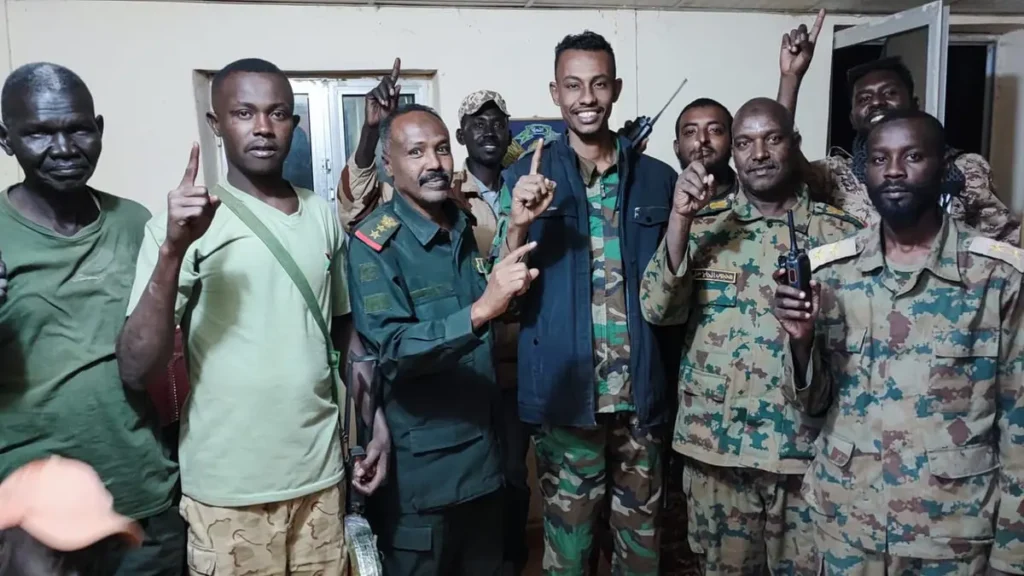
According to The Sudan Times, Burhan’s adviser did not stop there but “actively sought to persuade the ICC to accept the Qatari offer” — a move analysts describe as “an attempt by Burhan to distance himself from accusations of aligning with Islamists,” particularly after the United States officially designated the Islamist movement and its armed wing, the Al-Baraa bin Malik Battalion, as terrorist entities.
The battalion is an extremist militia fighting alongside the Sudanese army and is estimated by the US State Department to include around 20,000 fighters.
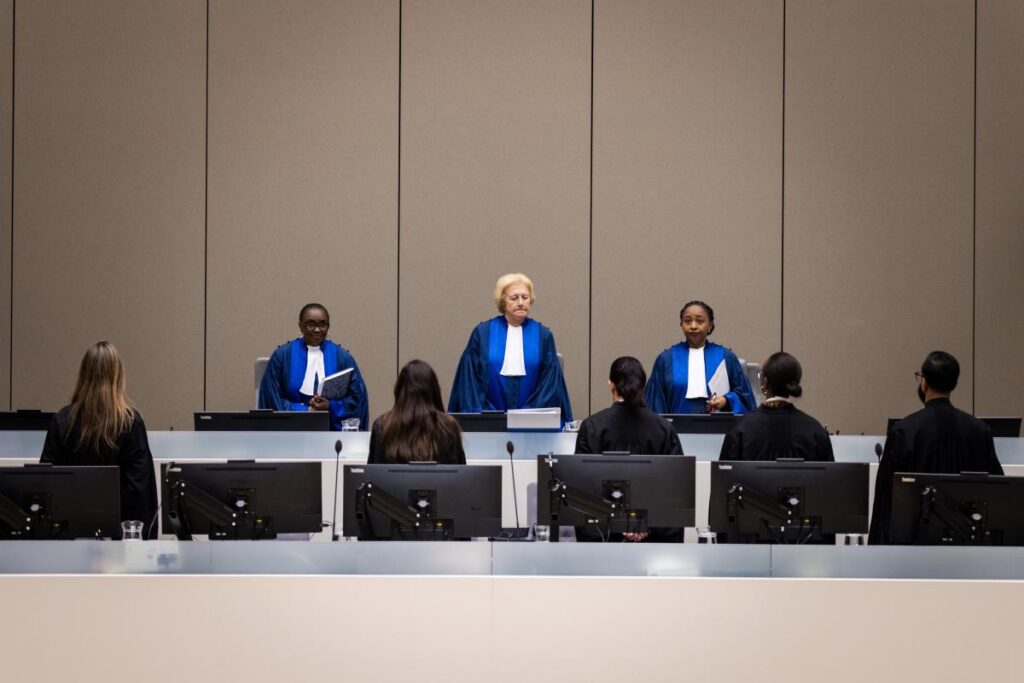
Observers cited by The Sudan Times noted that ICC cases related to Sudan are not limited to Bashir alone. Since his removal in April 2019, the court has also focused on other figures, most notably Ahmed Haroun, a senior Bashir-era official who re-emerged as a political and military actor after escaping prison following the outbreak of war in April 2023.
Legal experts warn that separating the trials of individual suspects could delay proceedings against Haroun, whose case is legally linked to others, including former Interior Minister Abdel Rahim Mohamed Hussein.
They also point to the conviction of Ali Kushayb on 27 charges related to crimes committed between 2003 and 2004 as an important legal precedent that could pave the way for future prosecutions of Haroun, Hussein, and possibly Bashir himself.
Secret Military Support
Regarding Qatar’s role, a report by Africa Intelligence points to “covert Qatari military support for the Sudanese army” and its Islamist allies, asserting that “Doha, as part of a broader proxy war, is backing army commander Abdel Fattah al-Burhan and supplying his forces with weapons.”
The report states that one of the airdrop operations conducted by the Sudanese army in El Fasher, North Darfur, during the past year — before Rapid Support Forces (RSF) advances there — “included weapons originating from Iran and Qatar,” with “Doha facilitating the transfer of arms to authorities in Port Sudan.”
It further explains that “Suhail Holding Group handled shipments of these drones, while Qatar Air Force Boeing C-17 Globemaster transport aircraft carried out at least four flights to Port Sudan between July 30 and October 2025.”
According to the report, “the Sudanese army dropped Iranian-made mortar shells over neighborhoods in El Fasher,” identifying them as long-range rounds equipped with AZ111-A base fuzes manufactured by Iran’s Defense Industries Organization, a conglomerate of Iranian arms companies.
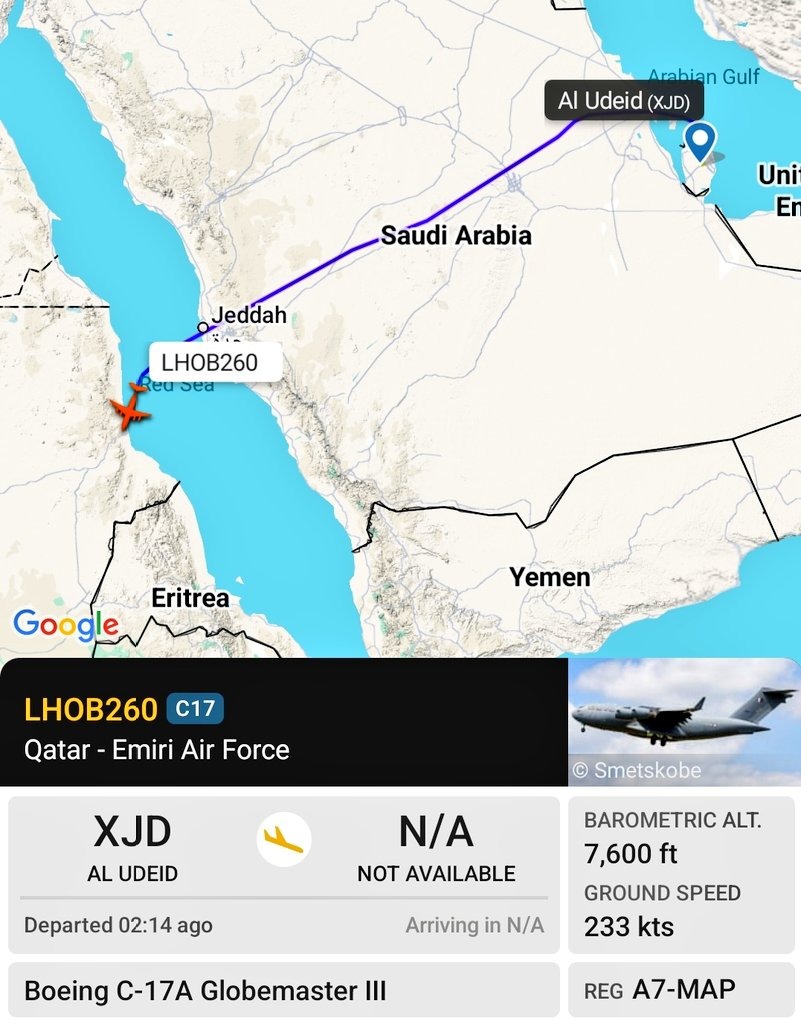
This month a Qatar Emiri Air Force C-17A Globemaster transport aircraft (Reg. A7-MAP, callsign LHOB260) departed Al Udeid Air Base and has arrived in Port Sudan
On this undeclared Qatari support, a report by the Washington-based Middle East Forum states that “during 2025, Burhan rejected the joint statement issued by the Quad mechanism (the United States, UAE, Egypt, and Saudi Arabia), which proposed a roadmap for a ceasefire in Sudan followed by peace negotiations between the warring parties, while simultaneously ending any future role for the Muslim Brotherhood.”
The report also recalls a proposal “presented by Burhan in Doha suggesting that Qatar and Turkey mediate between him and RSF commander Mohamed Hamdan Dagalo.”
According to the Forum, “Burhan’s proposal represented a direct challenge to the Quad and further reinforced his alliance with Islamist factions.”
The Middle East Forum argues that “the proposal for Qatari-Turkish mediation effectively strengthens the influence of two major supporters of Islamist movements and the Muslim Brotherhood in Sudan through its political arm, the Islamic Movement.”
The proposal also coincided with statements by Islamist leaders such as former Sudanese Foreign Minister Ali Ahmed Karti, who denounced what he described as “blatant foreign interference.”