The European Institute for Peace and Governance (EIPG)
Across Europe, concerns about democratic resilience have moved from the margins of policy discussions to the center of political debate. While democratic institutions remain intact, policymakers increasingly warn that emerging technologies, foreign interference, political polarization, and declining public trust are creating new vulnerabilities for democratic governance. At the heart of these concerns lies the rapid rise of artificial intelligence and its growing role in shaping information environments, political communication, and public opinion.
For decades, democratic systems relied on a relatively stable information ecosystem in which traditional media organizations acted as gatekeepers of public discourse. Citizens could disagree politically while operating from a broadly shared understanding of facts and reality. That environment has changed dramatically. Social media platforms, algorithm-driven information systems, generative artificial intelligence, and synthetic media have transformed the way information is produced, distributed, and consumed. The result is an increasingly fragmented information landscape in which truth itself is becoming contested.
European institutions have identified disinformation and foreign information manipulation as major threats to democratic processes. Officials increasingly warn that hostile actors are exploiting digital platforms to influence elections, deepen social divisions, weaken trust in institutions, and undermine democratic legitimacy. New technologies have dramatically increased the speed, scale, and sophistication of these operations, making them more difficult to detect and counter.
The emergence of generative artificial intelligence has accelerated these concerns. AI systems can now produce highly convincing text, images, audio recordings, and videos at minimal cost. Deepfake technologies have become increasingly accessible, allowing malicious actors to fabricate speeches, manipulate public figures, and create false narratives capable of spreading rapidly across digital networks. Unlike earlier forms of disinformation, AI-generated content can be personalized, automated, and distributed at unprecedented scale. European policymakers fear that such capabilities could distort public debate and undermine electoral integrity.
Recent elections and political campaigns across Europe have demonstrated both the opportunities and risks associated with AI. Political actors are increasingly using artificial intelligence to communicate with voters, draft campaign materials, and expand outreach efforts. At the same time, fabricated content, manipulated images, and coordinated influence campaigns have raised concerns regarding electoral fairness and public trust. Experts warn that future elections may be increasingly shaped by synthetic information environments in which citizens struggle to distinguish authentic political communication from manipulated content.
The challenge extends beyond elections. Democratic governance depends fundamentally on trust. Citizens must believe that institutions operate fairly, that public information is reliable, and that political competition occurs within a framework of shared rules. Disinformation undermines these foundations by creating confusion, uncertainty, and suspicion. When citizens lose confidence in information sources, they may also lose confidence in democratic institutions themselves. This erosion of trust can contribute to political polarization, weaken social cohesion, and increase support for anti-democratic narratives.
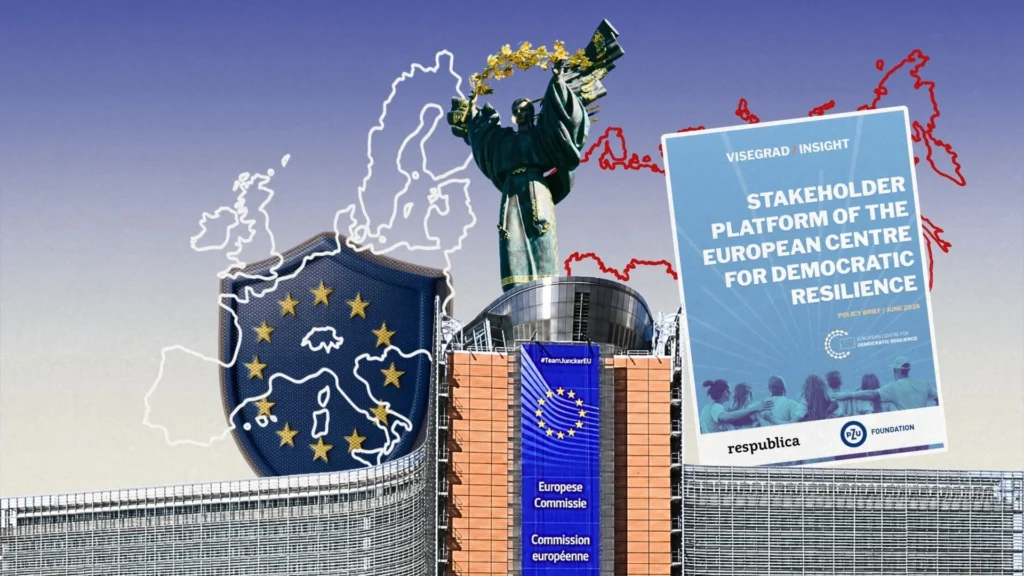
The European response has become increasingly comprehensive. The European Commission has launched initiatives aimed at protecting democratic processes, strengthening information integrity, and improving resilience against foreign interference. The creation of the European Centre for Democratic Resilience and the broader European Democracy Shield reflects a growing recognition that democratic security must now be understood as part of broader societal security. Rather than focusing solely on countering individual pieces of false information, policymakers are increasingly seeking to strengthen the resilience of institutions, media systems, and citizens themselves.
However, the challenge facing Europe is not simply technological. Artificial intelligence does not create democratic vulnerabilities on its own. Instead, it amplifies existing societal tensions. Political polarization, economic uncertainty, declining trust in institutions, and social fragmentation provide fertile ground for disinformation campaigns. AI may accelerate these dynamics, but it is not their root cause. Effective responses therefore require a broader governance approach that addresses underlying societal conditions alongside technological risks.
The governance dilemma is further complicated by Europe’s commitment to democratic values. Measures designed to combat disinformation must avoid undermining freedom of expression, privacy rights, and open political debate. Excessive regulation risks creating concerns about censorship and state control of information. Insufficient regulation, however, may leave democratic systems vulnerable to manipulation. European policymakers therefore face the difficult task of balancing security, liberty, and democratic accountability within a rapidly evolving digital environment.
Building democratic resilience in the AI era requires long-term investment in media literacy, civic education, institutional transparency, and public trust. Citizens must be equipped not only to identify false information but also to understand how algorithms, recommendation systems, and synthetic content influence public discourse. Schools, universities, journalists, civil society organizations, and public institutions all have a role to play in strengthening democratic awareness and critical thinking. Evidence from several European countries suggests that societal resilience is often more effective than purely technological countermeasures.
Looking ahead, the future of European democracy will depend not only on technological regulation but also on the ability of democratic institutions to adapt to a rapidly changing information environment. Artificial intelligence will continue to transform governance, public communication, and political participation. The challenge for Europe is not to resist these transformations but to shape them in ways that reinforce democratic values rather than weaken them.
The central question is no longer whether artificial intelligence will influence democracy. It already does. The real question is whether democratic governance can evolve quickly enough to preserve public trust, protect democratic participation, and strengthen social cohesion in an era defined by information abundance, technological disruption, and growing geopolitical competition.
Europe’s democratic future will be shaped not only by elections and institutions but also by the quality of its information environment. Artificial intelligence has introduced powerful new opportunities for participation, innovation, and public engagement. At the same time, it has created unprecedented challenges for information integrity, democratic accountability, and social trust. The ability of European societies to navigate this transformation will become one of the defining governance challenges of the coming decade. Strengthening democratic resilience is therefore no longer simply a political objective it has become a strategic necessity for preserving peace, stability, and democratic legitimacy across Europe.