How Migration Has Become a Strategic Tool in Modern Conflict
European Institute for Peace and Governance (EIPG)
Migration has long been understood primarily as a humanitarian and socio-economic phenomenon. However, in recent years, scholars and policymakers have increasingly recognized that migration can also function as a strategic instrument of geopolitical competition. The deliberate manipulation of migration flows by states or non-state actors to exert political pressure on adversaries has emerged as a growing concern in international security.
This study examines the concept of “weaponized migration,” analyzing how governments have used population movements as tools of coercion, destabilization, and diplomatic leverage. The research explores several case studies involving migration pressures on Europe, particularly along its eastern and southern borders.
The study argues that migration has become a key element of hybrid warfare strategies, where traditional military tools are combined with political, economic, and informational tactics designed to destabilize democratic societies.
Introduction
The movement of people across borders is one of the defining features of the modern global system. Migration flows are driven by a wide range of factors, including conflict, economic inequality, environmental change, and political instability. Traditionally, policymakers and scholars have focused on the humanitarian dimensions of migration, emphasizing the need for refugee protection and international cooperation.
However, recent geopolitical developments have highlighted a darker dimension of migration politics. Governments and armed groups have increasingly used migration as a tool to pressure neighboring states or regional blocs.
Political scientist Kelly Greenhill, who pioneered the concept of weaponized migration, defines it as the “deliberate creation or manipulation of cross-border population movements to induce political, military, or economic concessions from a target state.” (Greenhill, Weapons of Mass Migration, Cornell University Press).
Such strategies exploit the political sensitivity of migration in democratic societies, where large-scale population movements can generate domestic political tensions and strain government institutions.
Migration as a Tool of Hybrid Warfare
Hybrid warfare refers to the use of multiple forms of pressure—military, economic, informational, and political—to weaken an adversary without engaging in direct military confrontation. Migration has increasingly become part of this strategic toolkit.
Unlike conventional military operations, migration pressure operates indirectly. By facilitating or encouraging large-scale population movements toward a rival state, governments can create political and economic stress without formally crossing the threshold of armed conflict.
This tactic is particularly effective against democratic societies, where migration often becomes a deeply polarizing political issue. Large refugee inflows can strain public services, increase political tensions, and fuel the rise of populist movements.
According to a report by the European Council on Foreign Relations, migration pressure has become “a key element of contemporary hybrid conflict strategies directed at the European Union.” (ECFR Policy Brief, 2022).
In this context, migration becomes a geopolitical instrument rather than merely a humanitarian challenge.
The European Migration Crisis
The European migration crisis of 2015 marked a turning point in how policymakers understood migration as a security issue. During that period, more than one million refugees and migrants arrived in Europe, primarily fleeing conflicts in Syria, Iraq, and Afghanistan.
The sudden influx overwhelmed asylum systems in several European countries and triggered intense political debates about immigration policy, border security, and humanitarian obligations.
The crisis also exposed deep divisions within the European Union regarding responsibility-sharing and migration governance.
While the migration crisis was largely driven by conflict and instability in the Middle East, some analysts argued that regional actors exploited the situation to increase political pressure on Europe.
Migration quickly became one of the most politically sensitive issues in European domestic politics, influencing elections and shaping the rise of populist political movements.
Case Study: Belarus and the EU Border Crisis
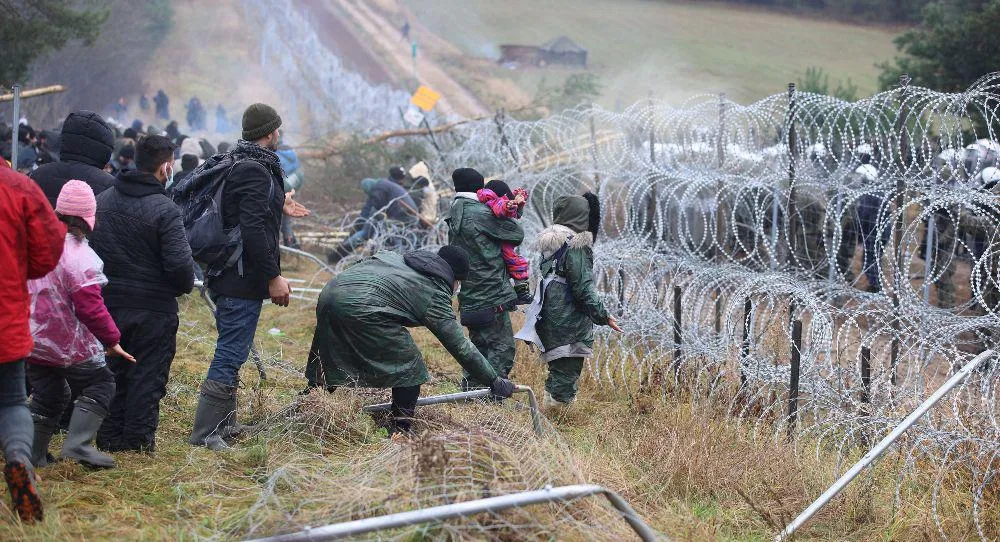
One of the clearest examples of weaponized migration occurred during the 2021 crisis on the border between Belarus and the European Union.
Belarusian authorities facilitated the arrival of thousands of migrants from the Middle East and encouraged them to cross into EU member states such as Poland and Lithuania. European officials accused the Belarusian government of deliberately orchestrating the migration flows in response to EU sanctions.
The European Commission described the situation as a form of “state-sponsored hybrid attack” designed to destabilize the European Union.
Migrants were reportedly transported to border areas and directed toward EU territory, creating humanitarian and security challenges for European border authorities.
This episode demonstrated how migration flows can be deliberately manipulated for geopolitical purposes.
Migration and Domestic Political Instability
One of the reasons migration pressure can be such an effective geopolitical tool is its impact on domestic politics within target states.
Large migration inflows can intensify political polarization, strengthen anti-immigration political movements, and undermine public confidence in government institutions.
Research by the Migration Policy Institute indicates that sudden migration surges often produce significant political reactions in receiving countries, particularly when governments appear unable to manage border controls effectively.
These political dynamics can weaken governments, disrupt coalition politics, and shift national policy debates.
From a strategic perspective, migration pressure can therefore create political instability without requiring military confrontation.
Policy Responses and Institutional Resilience
The increasing use of migration as a geopolitical tool presents significant challenges for European policymakers.
First, it blurs the line between humanitarian crises and security threats. Governments must balance the need to protect refugees with the need to defend borders against politically motivated migration pressure.
Second, migration weaponization highlights vulnerabilities within European governance structures. Differences in national migration policies and asylum procedures have complicated coordinated responses to migration crises.
Third, migration pressure can strain relations between EU member states, particularly when countries disagree about responsibility-sharing.
These challenges have prompted calls for stronger European migration governance and improved border security mechanisms.
Policy Responses and Institutional Resilience
European institutions have begun developing new strategies to address the security implications of migration.
The European Union has strengthened its border management agency, Frontex, and has increased cooperation with neighboring countries to manage migration flows.
In addition, European policymakers have emphasized the need for greater coordination between migration policy and foreign policy.
The European Commission’s New Pact on Migration and Asylum aims to create a more unified European framework for managing migration while addressing security concerns.
However, critics argue that current policies still struggle to balance humanitarian obligations with geopolitical realities.
Conclusion
Migration has become an increasingly important factor in global geopolitics. The deliberate manipulation of migration flows as a strategic tool represents a significant challenge for democratic societies.
For Europe, the weaponization of migration highlights the intersection between humanitarian policy, domestic politics, and international security.
Addressing this challenge will require a combination of diplomatic engagement, stronger institutional resilience, and coordinated migration governance across European institutions.
As geopolitical competition intensifies, migration is likely to remain a central feature of hybrid warfare strategies in the years ahead.
Understanding and responding to this phenomenon will therefore be essential for safeguarding democratic stability and maintaining international cooperation.