Prepared for: The European Institute for Peace and Governance (EIPG)
The continued use of shadow fleet and transshipment networks allow sanctioned countries to bypass energy sanctions, underscoring the need for stronger and more unified enforcement.
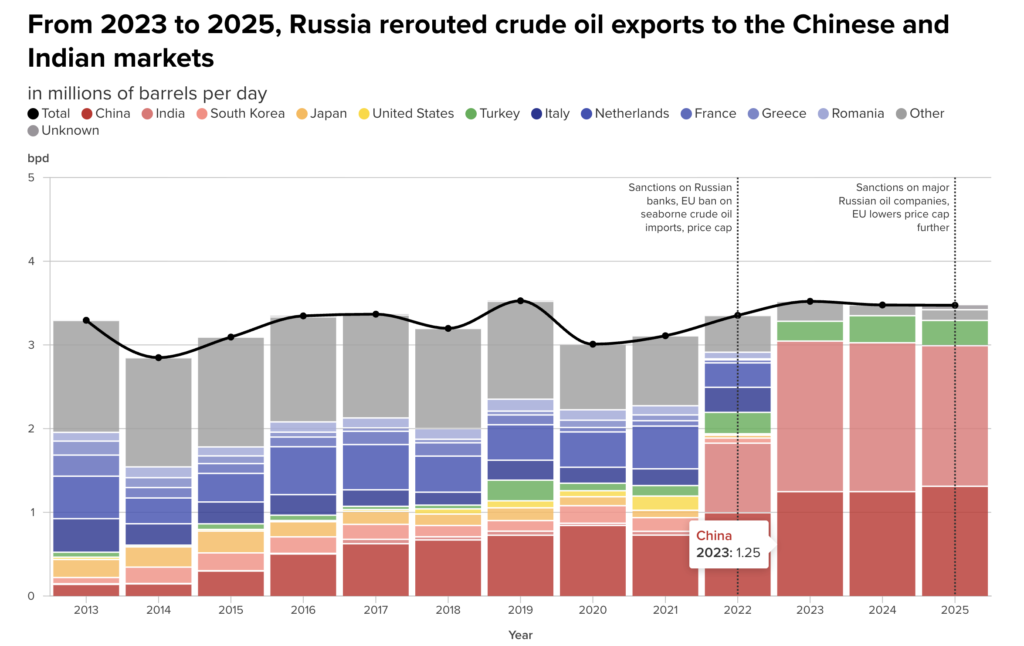
Intensifying competition among sanctioned oil exporters for a shrinking pool of buyers drove steep discounts in 2025, enabling China to save up to $28.8 million per day on imports at peak discount levels.
US sanctions waivers, rising oil prices, and supply shortages following the conflict in Iran have boosted demand for Russian crude. Since the waivers were issued, Russia has supplied approximately 300 million barrels to the international market as of May 11, with India re-emerging as a major importer and Southeast Asia emerging as a new destination for Russian crude.
Energy sanctions have become one of the most powerful tools of modern geopolitical competition. Over the past decade, the United States and its allies increasingly relied on sanctions targeting oil exports, shipping networks, financial institutions, and energy infrastructure to pressure states viewed as strategic threats, particularly Russia, Iran, and Venezuela.
However, the global energy market has adapted rapidly to this new era of economic warfare.
Instead of isolating sanctioned states completely, sanctions have contributed to the emergence of alternative trade networks, shadow shipping systems, covert financial channels, and new geopolitical alignments linking major energy producers with large consuming economies such as China and India.
The ongoing conflict involving Iran and disruptions in the Strait of Hormuz have further accelerated these transformations. As global oil markets face supply shortages and geopolitical instability, sanctioned crude oil has re-emerged as a critical source of global energy supply.
This evolving environment raises major strategic questions for Europe and the broader international community:
Can energy sanctions still function effectively in a fragmented global order? Are sanctions unintentionally strengthening rival geopolitical blocs? And how are global oil flows being reshaped by conflict, economic pressure, and strategic competition?
This research examines how the Iran conflict is transforming global crude oil flows, how shadow fleets and sanctions evasion networks operate, and what these developments mean for global governance, energy security, and the future of economic statecraft.
Energy Sanctions as a Tool of Geopolitical Power
Energy sanctions are designed to weaken targeted governments by restricting their ability to export oil and gas, limit foreign investment, and access global financial systems.
The United States and its allies have imposed extensive sanctions on Russia, Iran, and Venezuela in an attempt to constrain revenues used to finance military operations, regional influence, or authoritarian governance.
These sanctions include restrictions on:
- Oil exports
- Financial transactions
- Shipping insurance
- Maritime transport
- Energy technology transfers
- Access to Western banking systems
The strategy assumes that reducing energy revenues will increase economic pressure and force political concessions.
However, the global oil market is highly interconnected, making complete isolation extremely difficult.
Instead, sanctions have often reshaped energy trade routes rather than fully eliminating oil exports from targeted states.
The Emergence of the Global Shadow Fleet
One of the most significant unintended consequences of energy sanctions has been the rise of the global “shadow fleet.”
Shadow fleets consist of oil tankers operating through opaque ownership structures, hidden financial networks, false registrations, and deceptive maritime practices designed to evade sanctions enforcement.
These vessels frequently:
- Disable AIS tracking systems
- Manipulate location signals
- Conduct ship-to-ship transfers at sea
- Reflag under multiple jurisdictions
- Operate through shell companies
According to recent assessments, shadow fleet operations now play a central role in maintaining oil exports from sanctioned countries.
Russia, Iran, and Venezuela increasingly rely on these networks to continue supplying international markets despite sanctions pressure.
The growth of shadow shipping represents a major challenge for global maritime governance and sanctions enforcement mechanisms.
The Iran Conflict and the Strait of Hormuz Crisis
The conflict involving Iran and disruptions in the Strait of Hormuz created one of the most significant energy shocks in recent years.
The Strait of Hormuz is one of the world’s most critical energy chokepoints, carrying approximately 20 percent of global oil shipments.
Disruptions to shipping through the strait significantly reduced crude oil supplies reaching Asian and European markets, triggering fears of global shortages and rising energy prices.
As Gulf supplies became constrained, countries dependent on Middle Eastern oil began searching urgently for alternative suppliers.
This situation dramatically altered global demand patterns and unexpectedly strengthened the position of sanctioned oil exporters, particularly Russia.
Russia’s Return as a Strategic Energy Supplier
Following supply disruptions linked to the Iran conflict, the United States introduced temporary sanctions waivers allowing selected countries to import Russian crude oil to offset shortages.
These waivers significantly expanded Russia’s role in international energy markets.
According to recent calculations, Russia supplied approximately 300 million barrels of oil to global markets after the waivers were introduced.
India rapidly re-emerged as one of the largest importers of Russian crude, while Southeast Asian states including Indonesia, Thailand, Vietnam, and the Philippines also increased purchases.
This shift highlights a major contradiction in sanctions policy:
the same sanctions designed to isolate Russia became partially relaxed due to fears of global energy instability.
Russia therefore benefited economically from geopolitical disruptions that weakened competing energy suppliers.
China and the Strategic Use of Sanctioned Oil
China has become the central economic beneficiary of discounted sanctioned crude oil.
Throughout 2025, China imported massive volumes of discounted oil from Russia, Iran, and Venezuela. Analysts estimate that at peak discount levels, China saved up to $28.8 million per day through these imports.
Chinese refiners, particularly smaller independent “teapot refineries,” played a key role in sustaining demand for sanctioned crude.
At the same time, Beijing expanded strategic oil storage capacity aggressively, adding millions of barrels of reserve capacity as part of its long-term energy security strategy.
China’s approach demonstrates how large powers can exploit sanctions-driven market fragmentation to strengthen national energy resilience while reducing import costs.
The Weakening of Sanctions Enforcement
Although Western governments expanded sanctions enforcement efforts, major loopholes remain.
The continued operation of shadow fleets, transshipment networks, intermediary traders, and covert financial channels has significantly weakened the effectiveness of sanctions.
In many cases, oil cargoes are:
- Transferred between ships at sea
- Relabeled through third countries
- Blended with other crude supplies
- Re-exported under different origins
These tactics complicate tracking and enforcement efforts.
Moreover, enforcement coordination among the United States, the European Union, and allied states remains inconsistent.
As sanctions become more complex, evasion networks also become more sophisticated.
Europe’s Energy Security Dilemma
Europe faces a particularly difficult strategic challenge in this environment.
The war in Ukraine already forced European states to reduce dependence on Russian gas and diversify energy sources.
Now, instability in the Middle East further threatens Europe’s energy security.
European policymakers must therefore balance multiple priorities:
- Maintaining sanctions pressure on Russia and Iran
- Preventing energy shortages
- Avoiding economic instability
- Accelerating renewable energy transitions
- Preserving alliance unity with the United States
This balancing act is becoming increasingly difficult as geopolitical crises overlap.
The Geopolitics of Economic Statecraft
The current energy sanctions environment demonstrates both the power and limitations of economic statecraft.
Sanctions remain capable of:
- Increasing economic pressure
- Raising transaction costs
- Limiting investment
- Disrupting financial access
However, they also create incentives for:
- Alternative trade networks
- Parallel financial systems
- Strategic partnerships among sanctioned states
- Fragmentation of global governance systems
Russia, Iran, and China increasingly cooperate economically in ways designed to reduce vulnerability to Western pressure.
The long-term consequence may be the gradual emergence of competing geopolitical and economic blocs.
The Role of Financial Institutions and Private Actors
Financial institutions and private companies increasingly play a central role in sanctions enforcement.
Western authorities now pressure banks, insurers, shipping companies, commodity traders, and maritime registries to monitor suspicious transactions and identify sanctions evasion.
Recent enforcement strategies increasingly target:
- Maritime intermediaries
- Shipping insurers
- Foreign refineries
- Offshore financial hubs
- Shadow shipping networks
However, private-sector enforcement also creates risks involving legal uncertainty, uneven compliance, and geopolitical retaliation.
China’s recent decision to instruct companies not to comply with certain American sanctions reflects the growing politicization of global financial systems.
The Future of Energy Sanctions
The future effectiveness of energy sanctions will likely depend on several key factors:
First, Western states must improve coordination and enforcement consistency.
Second, policymakers must recognize that sanctions against major energy producers can generate global economic consequences that reshape international markets.
Third, sanctions strategies increasingly require integration with broader industrial, technological, and diplomatic policies.
Finally, the global transition toward renewable energy may eventually reduce the geopolitical influence of oil exporters altogether.
However, during the coming decade, fossil fuels will likely remain central to global power competition.
Conclusion
The Iran conflict and resulting disruptions in global oil markets are accelerating major transformations in the international energy system.
Sanctions against Russia, Iran, and Venezuela have not eliminated their role in global energy markets. Instead, they have contributed to the rise of shadow fleets, alternative trade networks, and new geopolitical alignments centered around energy security.
Russia has re-emerged as a critical supplier during global shortages. China has expanded its role as the primary buyer of discounted sanctioned crude. India and Southeast Asia increasingly balance geopolitical pressure against domestic energy needs.
These developments reveal the growing complexity of modern economic warfare.
Energy sanctions remain a powerful geopolitical tool, but their effectiveness is increasingly constrained by market adaptation, global fragmentation, and the strategic behavior of major powers.
For Europe and the broader international community, the challenge moving forward will be balancing sanctions enforcement, energy security, and geopolitical stability within an increasingly unstable and multipolar world order.