Hormuz, Bab al-Mandeb, and the Future of Maritime Power
European Institute for Peace and Governance (EIPG)
Global trade depends heavily on a small number of narrow maritime passages known as strategic chokepoints. These critical corridors connect major oceans, facilitate global energy flows, and enable the functioning of the international economic system. Among the most significant of these chokepoints are the Strait of Hormuz and the Bab al-Mandeb Strait, two maritime passages that connect the Persian Gulf and the Red Sea to the wider global economy.
Recent geopolitical tensions, particularly in the Middle East, have raised concerns about the vulnerability of these chokepoints to military conflict, naval blockades, and hybrid warfare tactics. This study examines the strategic importance of these maritime corridors and analyzes how geopolitical competition, regional conflicts, and emerging military technologies are reshaping maritime security.
The research argues that strategic chokepoints have become central arenas of geopolitical competition in the twenty-first century. As global energy markets remain heavily dependent on maritime transport, disruptions to these critical routes could have far-reaching consequences for global economic stability and international security.
Introduction
Throughout history, control of strategic maritime routes has played a decisive role in shaping global power. From the Mediterranean trade routes of the Roman Empire to the colonial sea lanes of the nineteenth century, maritime corridors have long served as arteries of global commerce and geopolitical influence.
In the modern era, the global economy remains deeply dependent on maritime trade. Approximately 90 percent of global trade is transported by sea, making maritime security a cornerstone of global economic stability (UN Conference on Trade and Development, UNCTAD Maritime Transport Report).
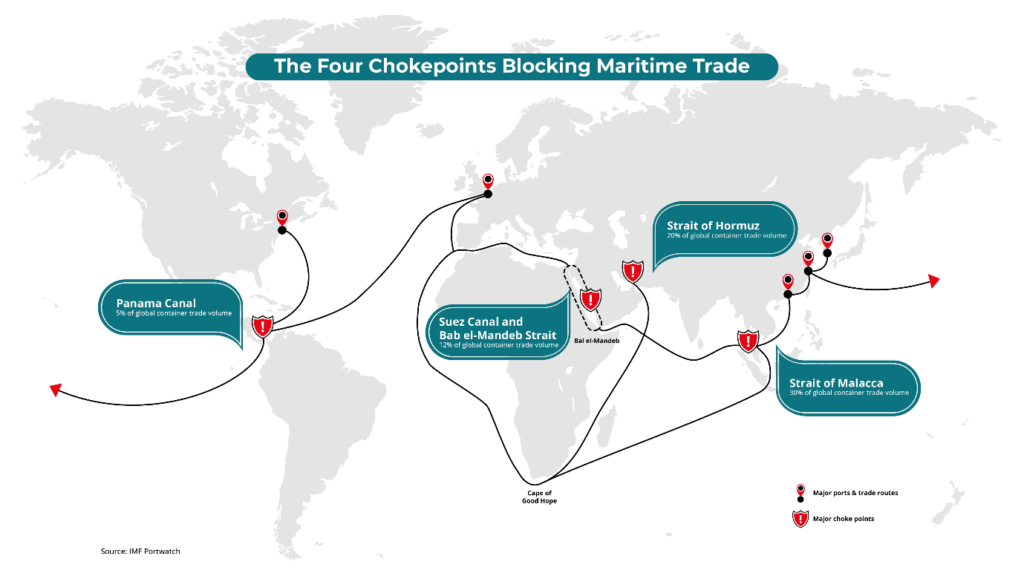
Within this global maritime system, certain narrow passages serve as essential gateways connecting major trade routes. These passages—commonly referred to as chokepoints—include the Strait of Hormuz, Bab al-Mandeb, the Suez Canal, the Malacca Strait, and the Panama Canal.
Among these, the Strait of Hormuz and Bab al-Mandeb occupy particularly important positions within the global energy network. Their strategic significance has grown even more pronounced as geopolitical tensions in the Middle East have intensified.
The Strait of Hormuz: The World’s Most Critical Energy Corridor
The Strait of Hormuz is widely regarded as the most important oil transit chokepoint in the world. Located between Iran and the Arabian Peninsula, the strait connects the Persian Gulf to the Gulf of Oman and the Arabian Sea.
According to the U.S. Energy Information Administration (EIA), roughly 20 million barrels of oil per day pass through the Strait of Hormuz, representing nearly one-fifth of global petroleum consumption.
The strait also serves as a major route for liquefied natural gas (LNG) exports, particularly from Qatar, one of the world’s largest LNG producers.
Because so much of the world’s energy supply passes through this narrow waterway, any disruption to shipping traffic could have immediate global consequences. Energy markets are highly sensitive to developments in the strait, and even the perception of potential disruption can trigger sharp increases in oil prices.
Geographically, the strait is highly vulnerable. At its narrowest point, it is approximately 33 kilometers wide, and the shipping lanes used by tankers are only a few kilometers across. This narrow geography makes the strait particularly susceptible to military interference.
Bab al-Mandeb: The Gateway Between the Red Sea and the Indian Ocean
The Bab al-Mandeb Strait serves as another critical maritime chokepoint connecting the Red Sea to the Gulf of Aden and the Indian Ocean. This passage lies between Yemen on the Arabian Peninsula and the Horn of Africa.
Bab al-Mandeb functions as a vital link in the trade route connecting Europe and Asia through the Suez Canal. Every year, thousands of commercial vessels pass through the strait transporting oil, natural gas, manufactured goods, and agricultural products.
According to international shipping data, approximately 6 million barrels of oil per day transit the Bab al-Mandeb Strait, making it one of the most important energy corridors in the global economy.
The strait’s importance has grown significantly due to the expansion of global trade between Asia and Europe.
However, the strategic location of Bab al-Mandeb also makes it vulnerable to regional instability.
Regional Conflicts and Maritime Vulnerability
Both Hormuz and Bab al-Mandeb are located in regions characterized by geopolitical tension and armed conflict. These conflicts have increasingly spilled over into maritime domains.
In the Persian Gulf, tensions involving Iran, Gulf states, and international powers have repeatedly raised concerns about potential disruptions to shipping through the Strait of Hormuz.
Iran has developed a naval strategy based on asymmetric warfare, utilizing fast attack boats, naval mines, anti-ship missiles, and drones. This strategy is designed to exploit the narrow geography of the strait.
Meanwhile, the Bab al-Mandeb Strait has been affected by the ongoing conflict in Yemen. Armed groups operating in the region have targeted shipping vessels using missiles, drones, and explosive boats.
Such incidents highlight the vulnerability of global trade routes to regional conflicts.
The Militarization of Maritime Chokepoints
The growing strategic importance of maritime chokepoints has led to increased militarization in surrounding regions. Several countries maintain naval bases and military installations near these critical passages.
The United States Fifth Fleet, headquartered in Bahrain, regularly patrols the Persian Gulf and surrounding waters to ensure freedom of navigation through the Strait of Hormuz.
Similarly, multiple international naval forces operate in the Red Sea and Gulf of Aden to protect shipping routes near Bab al-Mandeb.
These naval deployments are designed to deter attacks on commercial vessels and maintain the stability of global trade routes.
However, the concentration of military forces in these regions also increases the risk of accidental escalation.
Emerging Technologies and Maritime Warfare
Technological developments are also reshaping the strategic dynamics of maritime chokepoints. The proliferation of drones, autonomous systems, and long-range precision weapons has increased the vulnerability of maritime infrastructure.
Unmanned aerial vehicles can conduct surveillance on shipping lanes, identify targets, and carry out precision strikes against vessels or port facilities.
Autonomous naval drones are also being developed for mine warfare, reconnaissance, and anti-ship operations.
According to analysts at the International Institute for Strategic Studies (IISS), the growing use of drones and autonomous systems represents a major shift in naval warfare.
These technologies enable relatively weaker actors to challenge powerful naval forces through asymmetric tactics.
Global Economic Consequences
Disruptions to major maritime chokepoints could have severe consequences for the global economy.
Because global supply chains depend heavily on maritime transport, even temporary interruptions to shipping routes can create widespread economic instability.
Energy markets are particularly sensitive to disruptions in chokepoints such as Hormuz and Bab al-Mandeb. Oil price spikes following geopolitical tensions in these regions illustrate the direct link between maritime security and global economic stability.
The International Energy Agency has repeatedly warned that maintaining secure energy transit routes is essential for global economic resilience.
The Future of Maritime Security
The increasing strategic importance of maritime chokepoints suggests that these regions will remain focal points of geopolitical competition in the coming decades.
As global trade continues to expand and energy demand grows, the security of maritime corridors will remain a critical concern for policymakers.
International cooperation will be essential to maintain freedom of navigation and prevent disruptions to global trade.
Multinational naval operations, improved maritime surveillance, and diplomatic engagement may help reduce the risk of conflict in these sensitive regions.
Conclusion
Strategic maritime chokepoints such as the Strait of Hormuz and the Bab al-Mandeb Strait play an indispensable role in the functioning of the global economy. Their importance in global energy markets and international trade makes them key arenas of geopolitical competition.
The growing militarization of these corridors, combined with regional conflicts and emerging military technologies, has increased the vulnerability of global maritime trade.
Ensuring the stability of these critical passages will require sustained international cooperation, robust maritime security frameworks, and diplomatic efforts to reduce geopolitical tensions.
In an increasingly interconnected world, the security of a few narrow waterways may ultimately shape the stability of the entire global economic system.