The European Institute for Peace and Governance (EIPG)
In the summer of 2024, while regional and international attention was focused on the Saudi city of Jeddah where diplomatic mediation rounds were being held to halt the war in Sudan a very different operation was unfolding far from the negotiating rooms.
At a time when Saudi Arabia was hosting talks aimed at securing a ceasefire between the Sudanese Armed Forces and the Rapid Support Forces, a shipment of compressed liquid chlorine gas began its journey through the commercial shipping network of the Red Sea, heading toward Sudan.
On paper, the operation appeared entirely routine: an industrial substance widely used for water disinfection, standard shipping documentation, and a familiar trade route passing through major ports in the region.
However, a series of documents, maritime shipping records, and images that later emerged from conflict zones suggest that this shipment did not remain within its usual industrial context.
This investigation traces the journey of a shipment consisting of 17 large cylinders of liquid chlorine that departed from India, crossed the Red Sea via the port of Jeddah, and ultimately reached Sudan where one of the cylinders later appeared near active fighting north of Khartoum.
The investigation follows the full trajectory of the shipment and raises a central question that goes beyond this single container: how do dual-use materials, legally transported through commercial trade routes from a port like Jeddah, become potential tools of war in Sudan? And how can “civilian” import networks, in times of conflict, function as channels that facilitate the movement of highly sensitive materials, eventually finding their way into active battlefields in a country engulfed in open war?
Thread One: A Serial Number That Leads to the Sea
In a short video, a yellow metal cylinder appears lying near an area of active fighting north of Khartoum. Clear impact marks on its surface suggest it fell from a height. But the most important detail was not its appearance it was the number stamped onto its metal body.
After zooming in and enhancing the contrast, the full serial number becomes visible: GC-1983-1715 In the compressed gas industry, such numbers are not printed arbitrarily. They serve as traceable industrial identifiers linked to precise production records, which are then included in shipping documents specifying the export date, port of origin, vessel, and consignee.
As hazardous materials supply chain expert Sarah Gustav explains: “When you have the cylinder number, you effectively have the key to its entire logistical record. Every barrel carries its history with it.”
Once the number was confirmed, searches were conducted across maritime shipping databases and records of chemical exports from India during July 2024. The match revealed that the cylinder was part of a shipment of 17 compressed liquid chlorine cylinders, which departed India on July 14, 2024, from Nhava Sheva Port near Mumbai. The shipment was destined for Port Sudan, with a transit stop at the port of Jeddah in Saudi Arabia.
At this point, this is no longer a case of an “unknown barrel,” but a specific cylinder within a documented production batch, one that departed on a known date and followed a maritime route that can be reconstructed with precision.
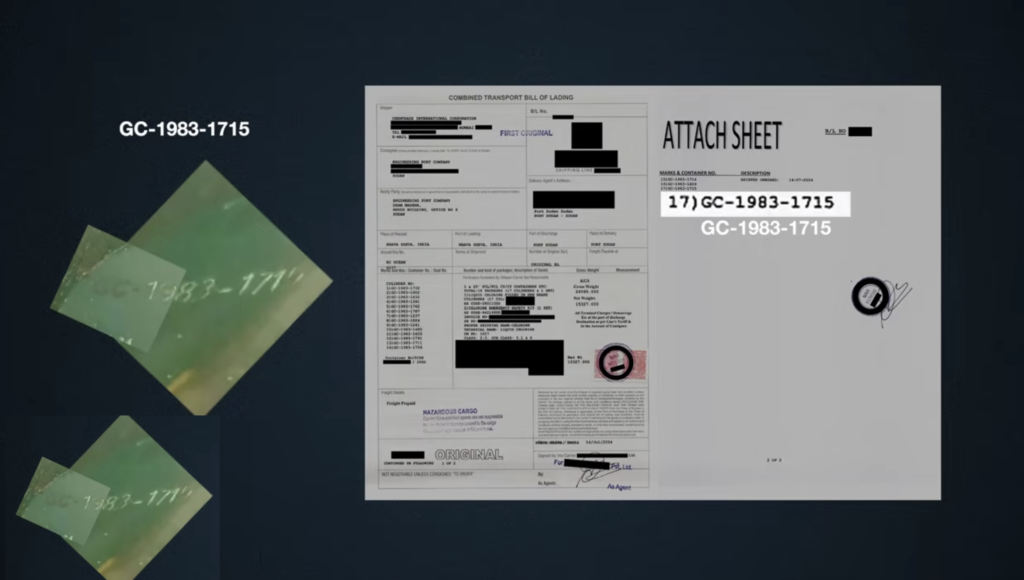
Vessel tracking data confirmed that the shipment departed India in mid-July and arrived in Jeddah a week later as part of a transit stage, before being transferred onto a second vessel bound for Port Sudan, where it arrived on August 9, 2024.
A few days later, the shipment was received inside Sudan.
With this serial number, the cylinder was transformed from an unidentified metal object into an entry point into a complete logistical archive. Once its arrival in Sudan in August 2024 was established, the next question became inevitable: who received it? And who had the capacity to transport it from the port to its final destination in a country experiencing an open war?
At this point, the investigation was no longer about an industrial substance alone, but about a chain of decisions, transport routes, and control mechanisms within a conflict environment. The cylinder seen in the footage was not isolated from its context; it was part of a recent shipment that had entered the country only weeks before appearing near a strategic military site.
Here, the next thread begins: identifying the receiving entity and tracing the movement from sea to inland.
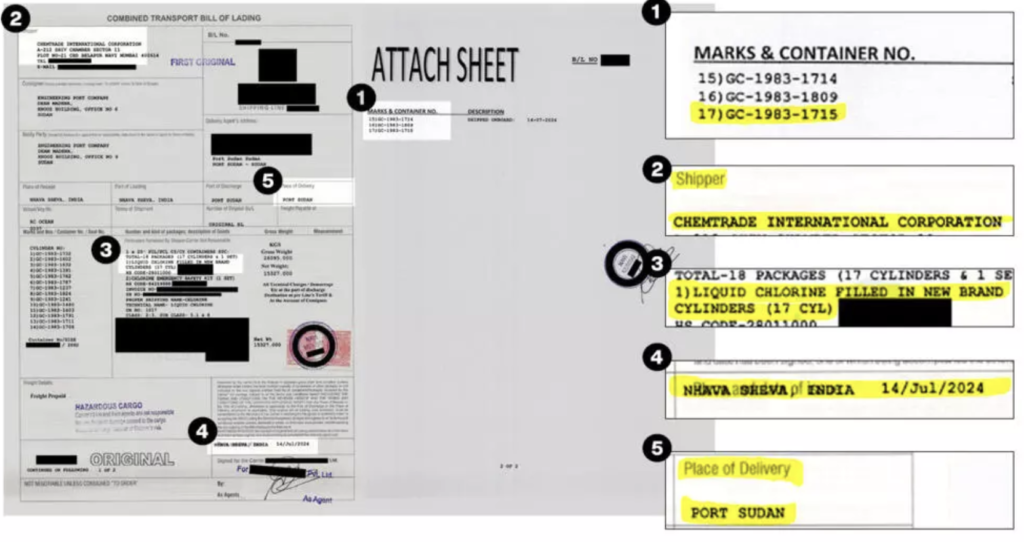
The shipment document shows that the cylinder bearing the serial number GC-1983-1715 was part of a shipment of 17 compressed liquid chlorine cylinders. The shipment was supplied by Chemtrade and departed from Nhava Sheva Port near Mumbai on July 14, 2024, bound for Port Sudan.
The Chlorine Shipment
Shipping documents related to the operation reveal that the cargo consisted of liquid chlorine gas, one of the most widely used chemicals globally in water treatment and chemical industries.
According to export records, the substance was stored in 17 large industrial cylinders known in the industry as “tonners” heavy metal containers used to transport compressed gases in industrial quantities. The total weight of the gas contained in these cylinders exceeded 15 tonnes of compressed liquid chlorine.
These cylinders are typically used to operate large-scale water treatment facilities or in chemical industries that rely on chlorine as a raw material. However, their physical properties, their large size and the high pressure of the gas they contain also make them capable of being used in entirely different ways outside their intended industrial context.
Dr. Dan Kista, a researcher specializing in chemical weapons and dual-use materials, explains: “Industrial chlorine cylinders are not designed as weapons, but they can easily be turned into a means of releasing gas if used outside their intended industrial systems. The problem is not the substance itself, but how it is used.”
Experts in hazardous materials management also note that tonners, in particular, are the most common method for transporting chlorine in large quantities. At the same time, they become extremely dangerous if ruptured or leaked in an uncontrolled environment.
Edward Martinos, a former hazardous materials expert who worked with UN programs in conflict zones, says: “When we talk about a chlorine cylinder of this size, a gas leak in an open area can affect a wide area within minutes. That’s why they are usually subject to very strict transport and storage procedures.”
Export documents show that the apparent supplier of the shipment was an Indian company trading in chemical materials, while the declared destination in the shipping papers was Port Sudan on the Red Sea.
This trade route from India to Sudan via the Red Sea appears, on the surface, to be part of normal industrial trade flows in the region.
However, what happened after the shipment arrived in Sudan raises broader questions about the path this material took once it entered the country.
The Grey Zone
After leaving the Indian port, the shipment entered a transit phase through the Red Sea, one that often passes with little scrutiny in global trade routes. Shipments moving through ports under a transit system are not treated as imports into the host country, but rather as goods in passage toward another destination.
In the case of this chlorine shipment, vessel tracking data and port records show that the containers carrying the cylinders arrived at Jeddah Islamic Port, one of the largest commercial ports on the Red Sea where they remained for approximately 18 days before being reloaded onto another vessel bound for Sudan.
This type of transit is common in maritime trade, as major ports function as redistribution hubs for goods moving from Asia to Africa or the Middle East. However, this very stage represents what supply chain experts describe as a “grey zone” in the movement of sensitive materials.
Mark Bromley, a researcher in the Armament and Military Technology Programme at the Stockholm International Peace Research Institute (SIPRI), explains:
“Dual-use goods often pass through multiple ports before reaching their final destination. During the transit phase in particular, oversight becomes more complex, because the shipment does not officially enter the economy of the country it passes through.”
Bromley adds that international control systems tend to focus on the point of export and the final point of import, while intermediate stages remain less scrutinized.
This challenge has become more pronounced in modern conflicts, where industrial materials can move through complex networks of ports and shipping companies before reaching conflict zones.
A study by C4ADS, a center specializing in tracking commercial networks linked to conflict, indicates that dual-use materials such as industrial chemicals often move through “civilian supply chains that appear entirely legitimate” before being redirected to military actors.
A 2025 report by the center on supply chains in conflict zones states:
“The issue with dual-use materials is not the legality of the trade itself, but the ability to redirect these materials once they arrive in a country with weak oversight or conditions of war.”
In the case of the chlorine shipment tracked in this investigation, the data indicate that its stay in Jeddah fell within standard maritime transit procedures. However, this stage represents a critical point in the shipment’s journey, as it was subsequently transferred onto another vessel heading directly to Sudan.
Dr. Dan Kaszeta, a chemical defense expert and former advisor on chemical weapons, explains: “Industrial materials like chlorine move through international trade every day. The real challenge is not transporting them, but understanding what happens to them once they arrive in a country experiencing armed conflict.”
In modern wars, sensitive materials do not always move through covert smuggling routes; they can travel through the same commercial systems that carry civilian goods. It is precisely here that the grey zone emerges between declared civilian use and their potential use on the ground.
From Port to Battlefield: The Timeline That Connects Everything
Logistical data linked to the shipment reveal that its journey did not end at the stage of routine commercial transport. After leaving India, the chlorine cylinders entered a transit phase through Jeddah Islamic Port under the maritime transit system, where they remained for approximately 18 days before being reloaded onto another vessel bound for Sudan.
On August 8, 2024, the cylinders were loaded onto the vessel ALAHMED, a commercial ship operating within Red Sea shipping routes. Just one day later, on August 9, 2024, the vessel arrived at Port Sudan, which, since the outbreak of the war, has become the main maritime gateway for the Sudanese government.
Up to this point, the route appears purely logistical: a shipment of industrial chemical materials moving from one port to another within normal regional trade flows. However, the timeline of events raises a different question.
Within weeks of the shipment’s arrival in Sudan, a large industrial chlorine cylinder matching in shape and size those used for transporting liquid chlorine began to appear in video footage captured in areas of active fighting north of Khartoum. The cylinder was seen near combat zones close to strategic facilities, suggesting that it had moved from its intended industrial pathway into a military environment within a short period of time.
This close temporal proximity between the shipment’s arrival at the port and the appearance of one of its cylinders on the battlefield highlights a stage that is often the least visible in wartime supply chains: the phase during which materials move from ports into the interior.
Under normal circumstances, chlorine cylinders used in water treatment projects go through a series of operational procedures before use, including storage in designated facilities and the installation of injection and calibration systems. However, in the case examined in this investigation, the timeline suggests a rapid from the port to an active military zone.
Dan Kaszeta, a chemical weapons expert and former advisor on chemical defense, explains: “In investigations involving dual-use materials, the timeline becomes as important as the material itself. When an industrial substance appears on a battlefield shortly after being imported, it raises legitimate questions about the path it took after entering the country.”
In modern conflicts, the story of a shipment does not end at the port. Instead, a more complex phase begins one in which industrial materials entering through civilian trade channels can quickly move through internal transport networks to reach locations they were never intended to reach.
In the case of this shipment, the distance between the dock in Port Sudan and the areas of fighting north of Khartoum appears to have been more than just a geographical span it was a critical link in the chain that transformed an industrial substance into an element present on the battlefield.
A Civilian Front… with a Military Footprint
After establishing the shipment’s route from India to Port Sudan, the most sensitive question remained: who received these cylinders?
Here, too, the document obtained by the investigation team provides the answer. It reveals that the shipment was not delivered to an ordinary civilian services company, but to a Sudanese firm named Engineering Port Company, based in the Deim district of Port Sudan a company with links to the Sudanese military.
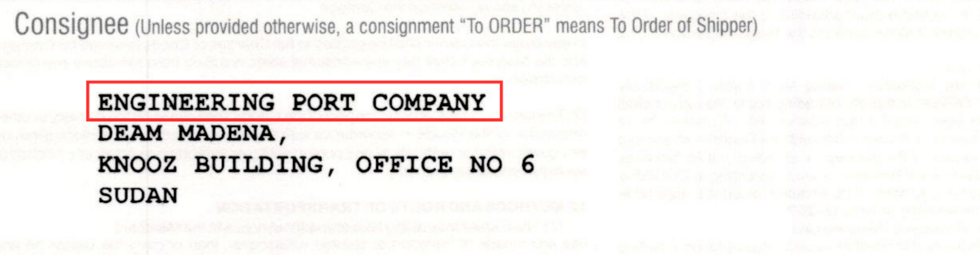
In this document related to the shipment of chlorine cylinders from the Indian company Chemtrade to Sudan, we identify the name of the consignee. It refers to a company based in the city of Port Sudan: Engineering Port Company (also known as Ports Engineering Company).
On the website of the Engineering Port Company, the firm is described as specializing in public works. The site specifically refers to its activities in “advanced water treatment,” which appears to indicate the production of potable water, although no further details are provided.
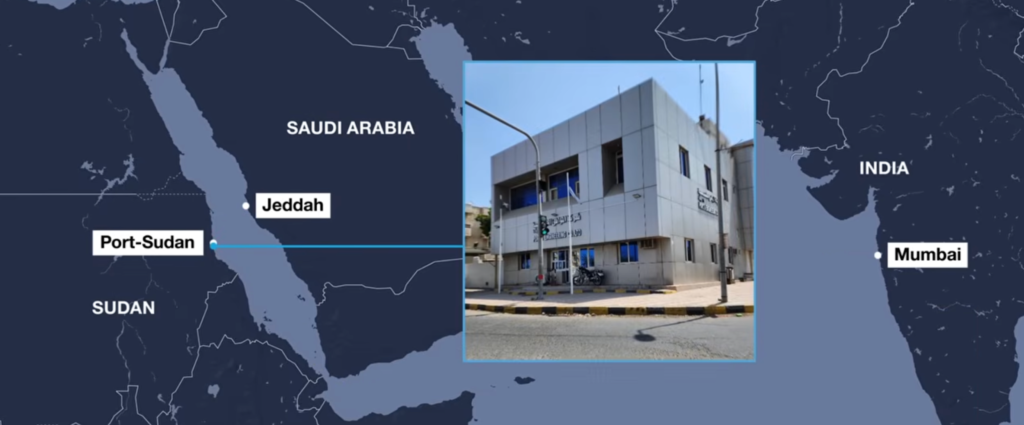
Indeed, chlorine is most commonly used in the production of potable water, as confirmed by Matteo Guidotti, a chemist and specialist in chemical weapons, who explains:
“Chlorine gas is a substance widely used for peaceful purposes. It can be used to disinfect drinking water and to produce plastics. These civilian uses distinguish chlorine from chemical weapons, which are typically developed with the intent to kill.”
However, a closer examination of the company’s administrative records reveals a different layer. The company is led by Mirghani Idris, an active officer in the Sudanese Armed Forces, while official images and statements indicate direct links between the company and state defense institutions.
This overlap between the “civilian” and the “military” is not a minor detail, but a critical point in understanding the shipment’s trajectory.
Mark Frankel, a researcher in security governance, explains: “Companies that operate under a civilian front but are managed by or linked to military structures become highly sensitive nodes. Legally, they are companies, but in practice, they are part of a broader network of influence.”
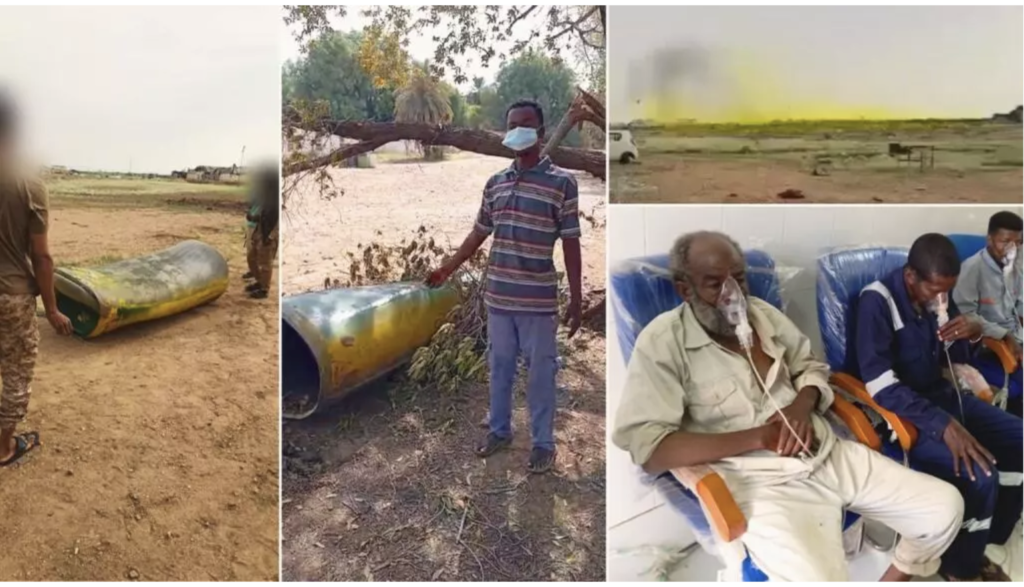
More importantly, this structure enables rapid redirection. The receiving company’s role is not limited to importation; it also controls customs clearance, internal transportation, and storage. In a country experiencing armed conflict, the actor that has access to ports, transport networks, and armed protection effectively holds the power to determine the shipment’s final destination within days.
Dr. Jane Zalandi, an expert in supply chains in conflict zones, explains: “In wartime, diversion does not always require smuggling. It is enough to have a company that imports legally, then redirects the materials internally within an existing network of influence.”
In this sense, the question is not only “who used the material?” but also “who enabled its arrival to the battlefield?”
How Does a Civilian Cover Become a Tool of War?
In contemporary conflicts, sensitive materials do not always move through shadowy routes or complex smuggling networks. Sometimes, they pass through the very same system, exploiting legal and procedural gaps known in international security discourse as the “grey zone.” This is a space where actions are not inherently illegal, yet they effectively allow for the redirection of end-use without leaving a clear trace.
Chlorine is a textbook example of a dual-use material. In civilian contexts, it is a key component in water disinfection and chemical industries. In military contexts, it can become a choking gas if released in certain ways. This contradiction creates a structural loophole: chlorine is not classified as a weapon at the point of export if its declared destination is civilian. It does not require a special military license. It does not carry the label of “military equipment.”
Dr. Mark Wittenis, a researcher at the Organisation for the Prohibition of Chemical Weapons (OPCW), explains:
“The danger of dual-use materials lies not in the substance itself, but in its convertibility. Oversight depends on intended use and intent does not always appear in documents.”
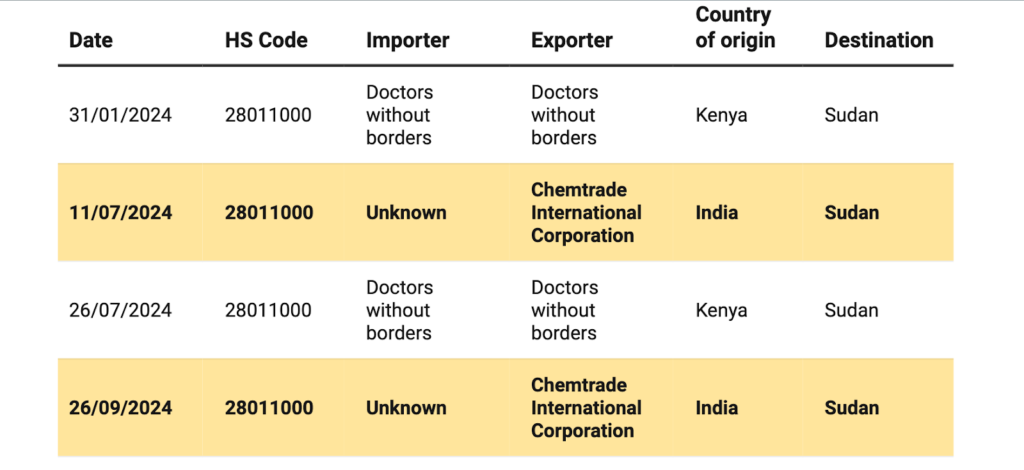
Data based on Sudanese supply records and export registries in Kenya and India (Source: Datawrapper)
From Supply to Accountability: Where Does Responsibility Begin?
Up to this point, the investigation reveals a chain of interconnected facts: a shipment of compressed liquid chlorine left India, crossed the Red Sea via Jeddah under a transit system, and then arrived at Port Sudan aboard a commercial vessel before one of its cylinders later appeared near active fighting north of Khartoum.
But tracing the shipment’s path raises a broader question than the mere movement of goods through ports: where does responsibility begin in such complex logistical chains?
Documents related to the shipment show that the receiving entity in Sudan was a company operating under a civilian front, presenting itself as a general services provider involved in sanitation and water treatment. However, an examination of the company’s structure reveals institutional links to the Sudanese military’s defense industries system, placing the shipment within a logistical network situated at the intersection of the civilian economy and the military establishment.
This type of overlap is not unusual in contemporary conflicts. Armed forces often rely on civilian or semi-civilian companies to manage importation, transportation, and storage operations allowing materials to move through standard commercial channels without appearing directly as part of a military supply chain.
However, the appearance of one of the cylinders near a combat zone shortly after the shipment’s arrival raises questions about the path these materials took once inside the country.
Under international law, chlorine itself is not a prohibited substance, as it is widely used in industrial applications and water treatment. However, its use determines whether it remains an industrial material or becomes an element with military applications.
Dan Kaszeta, an expert in chemical weapons, explains: “Chlorine is a very common industrial substance, but if it is released into the air in an uncontrolled environment, it becomes a dangerous choking gas. That is why the Chemical Weapons Convention focuses on use, not the substance itself.”
The Chemical Weapons Convention (CWC) prohibits the use of chlorine as a weapon in armed conflict, even though the substance itself is produced and traded for industrial purposes.
In light of this, the question does not stop at who imported the shipment or transported it across the Red Sea. It extends to what happened after it arrived in Sudan: how did these cylinders move from their intended industrial pathway into the vicinity of a battlefield?
In modern wars, sensitive materials do not always pass through covert smuggling routes or illicit networks. Sometimes, they move through the same commercial systems, benefiting from the overlap between economic and military interests, as well as weak oversight in conflict environments.
It is precisely here that the most complex zone of accountability begins:
between the companies that transport the materials, the entities that import them, and the networks that manage their movement after arrival.
In this case, the appearance of a chlorine cylinder on the battlefield opens a question that is no longer about a ship’s route or a bill of lading, but about a chain of decisions that extended from the port to the front line.
Chlorine Between Life and Death: The Paradox at the Heart of the Story
Under normal conditions, chlorine is one of the most widely used chemicals in the world for saving lives. By adding it to water systems, it can eliminate bacteria and parasites that cause serious diseases such as cholera and typhoid. The World Health Organization estimates that water chlorination has played a key role in reducing the spread of waterborne diseases globally over the past decades.
In countries with weak health infrastructure or facing humanitarian crises, chlorine becomes an essential, life-saving substance. A single industrial cylinder can produce large quantities of treated water enough to supply entire cities with safe drinking water.
Yet the same substance carries a different face in other contexts. When released into the air at high concentrations, chlorine becomes a choking gas that attacks the respiratory system, causes severe irritation to the eyes and skin, and in some cases can lead to fatal suffocation.
Dan Kaszeta, an expert in chemical weapons, explains: “Chlorine is not prohibited in itself because it is used daily in industry and water treatment. But if deliberately released into the air as a weapon, it becomes one of the most dangerous choking agents.”
This contradiction between civilian and military use makes chlorine a clear example of what international security experts refer to as “dual-use materials” substances that can save lives in one context and become tools of harm in another.
Access to safe drinking water remains a critical challenge in Sudan, where approximately 17.3 million people lack reliable access due to the destruction of treatment facilities, power outages, and displacement caused by the war.
This severe shortage of potable water has contributed to the spread of epidemics, particularly cholera. The White Nile State, where the Al-Tawila water distribution station is located, has been heavily affected since the beginning of the year. Between January and February 2025, around 2,700 people including 500 children were infected with the disease, according to UNICEF.
In a country like Sudan, where war has destroyed large parts of water systems and health infrastructure, this paradox becomes even sharper. Communities that depend on chlorine to disinfect water and prevent disease outbreaks may, at the same time, find themselves facing the same substance appearing near battlefields.
Thus, the question that began with the journey of a commercial shipment across the Red Sea grows into something larger than tracing its route: how can we ensure that industrial materials moving daily through global trade remain within their civilian use and do not, at some point, become part of the machinery of war?