New START was the last remaining pillar of bilateral nuclear arms control between the United States and Russia. Signed in 2010, the agreement limited each side to 1,550 deployed strategic nuclear warheads on intercontinental ballistic missiles, submarine-launched ballistic missiles and heavy bombers.
Its expiration on 4 February is symbolically profound. Yet the immediate military consequences should not be overstated. Both countries already possess the capacity to maintain strategic parity regardless of treaty limits. They may continue to respect the framework informally or increase the number of warheads deployed on existing missiles. The basic balance of deterrence will therefore persist in the short term.
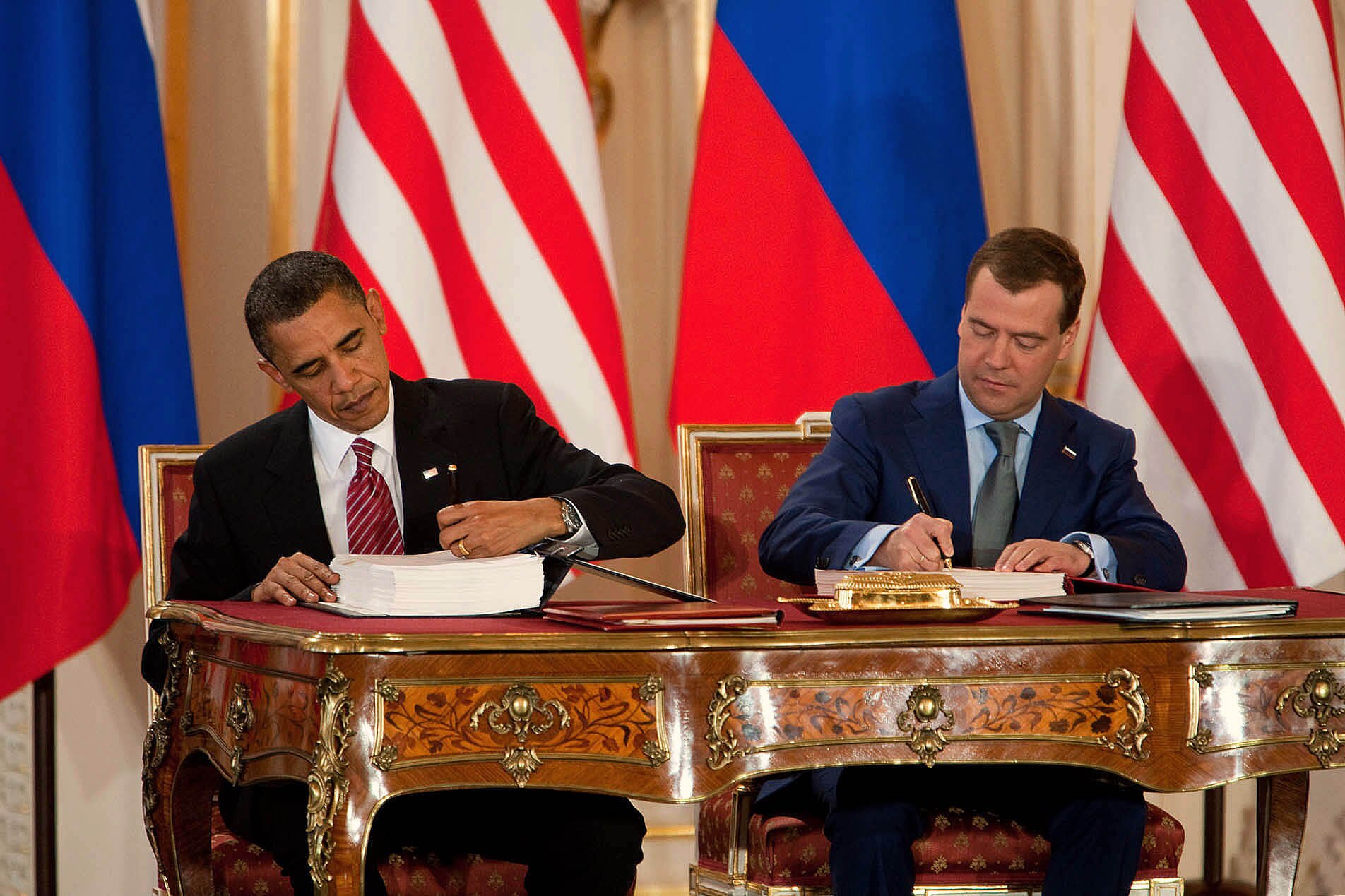
President Barack Obama and President Dmitry Medvedev of Russia sign the New START Treaty during a ceremony at Prague Castle in Prague, Czech Republic, April 8, 2010. Credit: Official White House Photo by Chuck Kennedy.
Deterrence without transparency
What truly destabilises the strategic nuclear balance is not warhead numbers themselves, but the erosion of transparency and verification, combined with the development of new Russian nuclear delivery systems that fall outside traditional arms control categories.
Both trends emerged while New START was still formally in force. Inspections were already restricted during the Covid-19 pandemic and effectively halted after Russia’s full-scale invasion of Ukraine. At the same time, Moscow continued to invest in new nuclear delivery concepts, some of which could qualify as strategic systems and thus should have been declared under New START, but were not.
Two prominent examples are Burevestnik, a nuclear-powered cruise missile theoretically capable of remaining airborne for long periods, and Poseidon, a nuclear-powered torpedo designed to strike coastal targets, including major US cities. The effectiveness of both remains uncertain. Sanctions, technological constraints and industrial limits cast doubt on their large-scale deployment.
However, the strategic purpose of such programmes is not purely military. Different forms of information warfare have long accompanied Moscow’s nuclear posturing to shape Western debate and public opinion. This ranges from the alleged 1950s bomber gap, when the Soviet Union convinced US policymakers that it possessed far more long-range nuclear bombers than it actually did, to the late-2025 use of a nuclear-capable Oreshnik missile against Lviv, a Ukrainian city near the NATO border, intended to signal escalation and unsettle European decision-makers.
This makes transparency and verification especially important. Mutual inspections and data sharing enhance stability and predictability in the nuclear realm. Their erosion deepens uncertainty and increases the risk that decision-makers default to worst-case assumptions.
China’s rise and Europe’s shrinking nuclear margin
Strategic nuclear stability between Washington and Moscow remains a core European interest despite the war in Ukraine. However, future arms control may also become structurally more complex. US President Donald Trump has expressed interest in a broader agreement that would include China, given Beijing’s rapid nuclear expansion. China is moving beyond a minimal deterrent posture towards a much larger and more sophisticated arsenal that could exceed 1,000 warheads in the coming years. Beijing has so far rejected participation in arms control negotiations, making any broader framework unlikely in the near term.
China’s expansion also raises difficult questions for Europe. The continent will remain the only major nuclear region relying solely on the comparatively limited forces of France and the United Kingdom. These forces are designed around strict sufficiency rather than the robust postures and arsenals maintained by the United States, Russia and, increasingly, China. The question is therefore whether Paris and London will confine themselves to ongoing modernisation or consider expanding their deterrents.
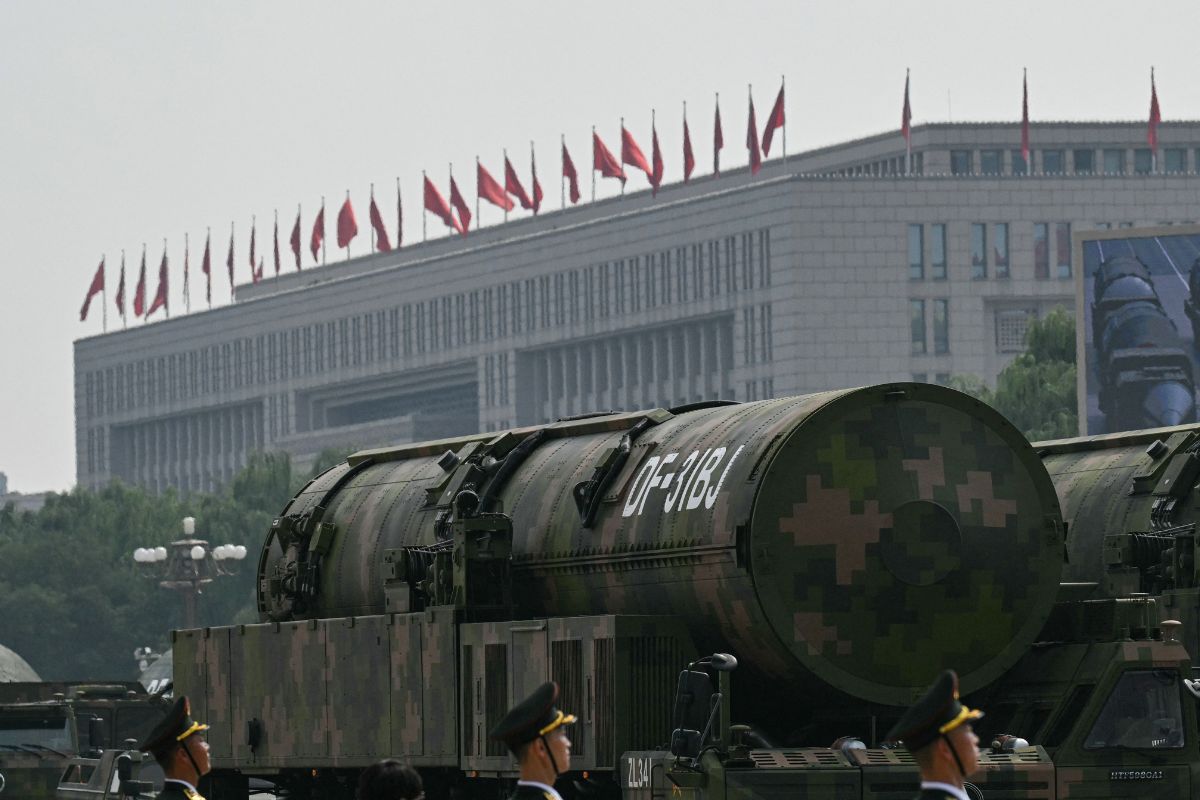
The DF-31BJ intercontinental ballistic missiles is seen during a military parade in Beijing’s Tiananmen Square on 3 September 2025. Photo by Greg Baker / AFP.
Europe’s tactical nuclear dilemma
Even if New START was revived and fully upheld, it would not address the most immediate challenge facing Europe: Russia’s large and growing arsenal of theatre-level, or tactical, nuclear weapons.
These shorter-range systems, typically lower-yield and intended for battlefield use, were never covered by New START. Their deployment in Europe was instead constrained by the 1987 Intermediate-Range Nuclear Forces Treaty, which banned an entire class of ground-launched missiles with ranges between 500 and 5,500 kilometres. That framework collapsed after Russia deployed the nuclear-capable 9M729 Novator cruise missile, which the United States and its allies judged to be a treaty violation, prompting Washington’s withdrawal from the INF agreement in 2019.
Russia is now fielding these systems close to NATO borders, including in Belarus. Europe, however, lacks an equivalent theatre-level nuclear deterrent. For instance, Paris’ nuclear strategy, most recently outlined in the 2025 National Strategic Review, rejects the notion of tactical nuclear warfare and therefore does not envisage the need to deter Russia’s tactical nuclear warheads with comparable capabilities. Instead, it maintains that any use of nuclear weapons would carry the possibility of full-scale nuclear retaliation. NATO’s only existing response remains the US B61 gravity bomb delivered by allied aircraft, a posture that depends heavily on the credibility of the American commitment to the Alliance – one that has been significantly undermined by the current administration.
Some analysts argue that France and the United Kingdom may eventually need to consider theatre-level options to counter Russia’s regional nuclear forces. Such debates remain politically sensitive but are likely to intensify as the security environment deteriorates.
Europe must also strengthen air and missile defence to prepare for scenarios in which deterrence fails. Beyond protecting key installations and infrastructure, effective defence requires a multilayered system, ranging from short-range defences against low-flying cruise missiles to high-altitude interceptors capable of countering ballistic threats. Recent incursions of Russian drones into Poland and other NATO countries have shown that the Alliance is not yet fully prepared to protect its airspace.
The world has entered a post-strategic arms control era defined by uncertainty, competition and declining trust. Europe cannot ignore this shift or rely on conventional deterrence alone. It must adapt to a harsher strategic landscape and reassess its nuclear posture accordingly.