The European Institute for Peace and Governance (EIPG)
Executive Summary
The war in Ukraine is increasingly evolving from a bilateral conflict between Russia and Ukraine into a wider international security confrontation shaped by the involvement of external powers. Military assistance, weapons transfers, sanctions, technological cooperation and the participation or support of states outside Europe have gradually expanded the number of actors with strategic interests connected to the outcome of the war.
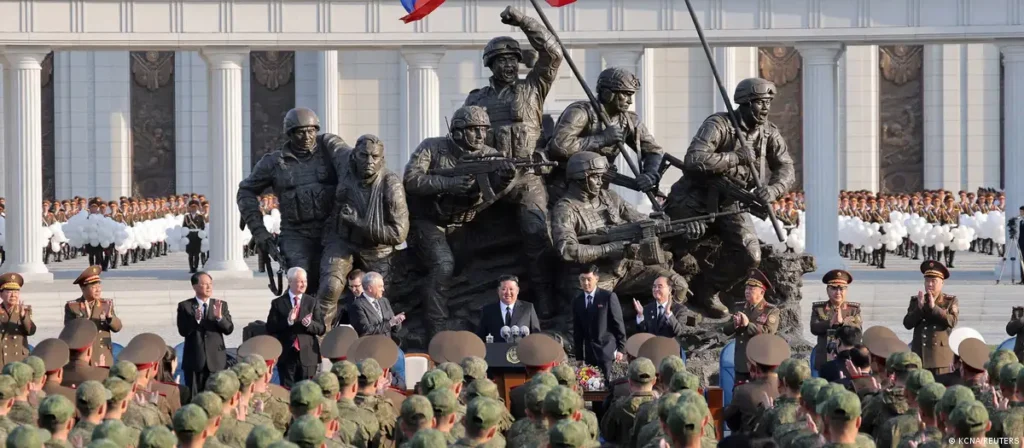
The deepening relationship between Russia and North Korea is one manifestation of this transformation. According to Ukrainian and South Korean assessments, North Korea has already provided Russia with large quantities of ammunition, ballistic missiles and military personnel, while reports in 2026 suggest that additional North Korean forces could eventually be deployed to Russian territory. At the same time, Ukraine remains heavily dependent upon military, financial and political support from European states and other Western partners.
The significance of these developments extends beyond battlefield calculations. Every additional external actor introduces another set of strategic interests into the conflict. What began primarily as a confrontation over Ukraine’s sovereignty and territorial integrity increasingly intersects with European security, NATO deterrence, Russian relations with Asia, Korean Peninsula security and the wider competition surrounding the international order.
This creates a major challenge for diplomacy.
Wars become more difficult to end when their military dynamics are connected to strategic relationships extending beyond the original parties. Russia’s cooperation with North Korea may strengthen Moscow’s capacity to sustain prolonged warfare, while Western assistance increases Ukraine’s ability to resist Russian pressure. External support can therefore prevent military defeat, but it can simultaneously reduce incentives for immediate compromise.
The result is a conflict in which neither side necessarily evaluates negotiations exclusively through conditions on the Ukrainian battlefield.
This paper argues that the internationalization of the Ukraine war is creating a new obstacle to peace. A sustainable settlement will eventually require more than negotiations between Moscow and Kyiv. It will need to address a broader security environment involving European deterrence, military assistance, sanctions, security guarantees and the growing involvement of external powers.
For European policymakers, the central challenge is therefore to maintain Ukraine’s ability to defend itself while preventing the conflict from evolving into an increasingly permanent international confrontation.
Introduction
The longer a war continues, the more difficult it becomes to separate its original causes from the geopolitical relationships created during the conflict.
The Ukraine war increasingly demonstrates this phenomenon.
Russia’s full-scale invasion began as an attempt to reshape Ukraine’s political and territorial future through military force. More than four years later, however, the conflict has generated an international network of military partnerships, economic dependencies and security commitments extending far beyond Russia and Ukraine.
North Korea’s growing involvement provides one of the clearest examples.
Moscow and Pyongyang signed a defence partnership in 2024, after which North Korea began supplying Russia with substantial quantities of ammunition and ballistic missiles and later deployed military personnel. Ukrainian authorities now claim that Pyongyang could significantly expand its presence in Russia. The exact scale of future deployments remains uncertain, and independent verification of the higher estimates remains important. Nevertheless, the strategic direction is clear: cooperation between Russia and North Korea has moved beyond conventional diplomatic relations toward increasingly substantial military coordination.
For Pyongyang, participation offers benefits extending beyond its relationship with Moscow.
The Ukraine battlefield provides North Korean forces with something that decades of military exercises cannot fully reproduce: direct exposure to contemporary high-intensity warfare.
North Korean personnel can observe drone operations, electronic warfare, artillery coordination, battlefield reconnaissance and the interaction between traditional military formations and rapidly evolving unmanned technologies. Veterans returning from Russia could potentially transfer this experience into North Korean doctrine and training.
This means that the consequences of the Ukraine war may eventually reach the Korean Peninsula.
Lessons learned on European battlefields could influence military capabilities thousands of kilometres away.
Russia may also benefit from the relationship in a different way. Additional personnel do not necessarily need to conduct direct assaults inside Ukraine to influence the battlefield. North Korean forces deployed to rear areas or Russian border regions could perform security, engineering, construction or logistical functions, potentially allowing Russian personnel to be reassigned elsewhere.
This demonstrates why measuring foreign involvement purely by the number of troops directly fighting on the frontline can be misleading.
Military manpower operates as a system. A soldier guarding infrastructure or performing engineering work can indirectly release another soldier for combat operations.
Yet Russia is not the only side whose war effort depends upon international relationships.
Ukraine’s ability to continue resisting Russia has been closely connected to European and wider Western military assistance. Air-defence systems, ammunition, financial assistance, intelligence cooperation and military training have all influenced Kyiv’s ability to sustain the war.
The conflict has therefore developed two increasingly international support structures.
This does not mean those structures are politically or legally equivalent. Ukraine is defending itself against Russia’s invasion, while Moscow initiated the full-scale war. But from the perspective of conflict dynamics, the growing role of outside powers matters because it increases the resources available for continued warfare.
This produces what peace and conflict studies describe as a fundamental problem of external support: international assistance can prevent defeat while simultaneously extending the period during which military options remain available.
For Ukraine, external support strengthens its ability to resist territorial concessions imposed through military pressure.
For Russia, external partnerships can reduce the effectiveness of attempts to isolate its war economy and constrain its military resources.
As long as both sides believe additional time could improve their negotiating position, incentives for major compromise remain weak.
This is why the internationalization of the war creates a difficult paradox for European peace policy.
Reducing support for Ukraine in the hope of accelerating negotiations could instead weaken Kyiv’s bargaining position and create incentives for further Russian military pressure. Continuing assistance without a credible diplomatic strategy, however, risks allowing the conflict to become structurally permanent.
The challenge is therefore not choosing between defence and diplomacy.
It is connecting them.
European governments need to consider how military assistance can support conditions for credible negotiations rather than treating military and diplomatic policy as entirely separate tracks.
The expansion of Russia’s international military partnerships makes this increasingly urgent.
North Korea demonstrates that attempts to pressure Russia cannot be understood exclusively within a European framework. Moscow has developed relationships capable of providing alternative sources of ammunition, personnel and political support. The longer the conflict continues, the more these relationships may become institutionalised.
That could make eventual peace more complicated.
A ceasefire between Russia and Ukraine would not automatically dismantle the military partnerships created during the war. Weapons cooperation could continue. Military technology transfers could deepen. North Korean personnel returning home could retain battlefield experience. European states could maintain significantly higher defence spending and stronger deployments along NATO’s eastern frontier.
In other words, the war could end while the security confrontation it created survives.
This distinction should be central to European peace planning.
The objective cannot simply be stopping battlefield violence. Sustainable peace requires addressing the political and security structures that make renewed conflict likely.
Ukraine would need credible assurances that a ceasefire would not simply provide Russia with time to rebuild its forces.
Russia would seek clarity regarding the future European security environment.
European governments would require mechanisms capable of monitoring agreements and responding to violations.
Questions involving sanctions, reconstruction, prisoners, displaced populations, territorial administration and military deployments would remain extraordinarily difficult.
External military involvement adds another layer to every one of these issues.
The growing participation of actors such as North Korea also demonstrates that Europe’s security environment can no longer be analysed independently from developments in Asia.
European and Indo-Pacific security are becoming increasingly connected through military technology, sanctions, defence production and strategic partnerships. A North Korean artillery shell used in Europe and battlefield knowledge acquired in Russia that later influences security on the Korean Peninsula are two sides of the same process.
This has important implications for European governance institutions.
European diplomacy will increasingly require coordination not only with Washington but with partners such as South Korea and Japan when dealing with sanctions enforcement, military technology transfers and the wider consequences of Russian partnerships in Asia.
Peace diplomacy itself must therefore become more internationally coordinated.
None of this means that negotiations are impossible.
It means that the architecture required to sustain an eventual peace is becoming more complex than the architecture required merely to produce a ceasefire.
A ceasefire can stop shooting.
A sustainable settlement must change the calculations that could restart it.
For the European Institute for Peace and Governance, this distinction is particularly important. The Ukraine war demonstrates that modern peace processes cannot be separated from governance, security institutions and international enforcement mechanisms. Agreements survive only when institutions exist to monitor commitments, manage disputes and impose credible consequences for violations.
Europe should therefore begin thinking beyond the immediate question of when negotiations might occur.
The more important question is what kind of peace architecture could survive after negotiations begin.
That architecture will need to recognise that the Ukraine war of 2026 is no longer shaped solely by Moscow and Kyiv. It has become embedded within a wider network of international military relationships whose consequences stretch from Europe’s eastern frontier to Northeast Asia.
Ending the fighting will consequently be only the first challenge.
Preventing the internationalized confrontation created by the war from producing the next conflict may prove considerably harder.