The European Union is preparing to adopt its 20th sanctions package targeting Russian oil exports in a bid to further constrain Moscow’s ability to finance its war machine. Although currently blocked by Hungarian and Slovak vetoes, the package would, if approved, effectively end the current price-cap regime.
Instead of allowing shipments below a set price threshold, the EU would move to an outright ban on maritime services – including insurance, shipping, financing, port access and technical support – for the transport of Russian crude and petroleum products, regardless of sale price.
The shift is significant. Around 20% of Russian oil exports are carried by tankers owned or insured by EU entities. The Kyiv School of Economics estimates the move could reduce exports by 1.4 million barrels per day in late 2026 (an 18% drop from 2025 levels) and by 0.8 million in 2027 (an 11% decline).
Critics doubt the impact will be so sharp. They argue Russia will further expand its reliance on the so-called shadow fleet, ageing tankers operating outside Western insurance and regulatory systems. While the package would add 43 vessels to the EU sanctions list, bringing the total to roughly 640, these ships are neither EU-owned nor EU-insured, limiting the direct effect of the services ban.
Hiding in its shell: Russia’s shadow fleet buildup
Russia’s shadow fleet has grown from a sanctions-evading workaround into a geopolitical force disrupting global markets. Globally, shadow fleets are estimated to manage over 12% of sea-borne trade and nearly half of large commercial oil tankers, commanding 1,300 vessels by the end of 2025. The shadow fleet is also propping up Russia’s wartime economy, allowing for its war of aggression to persist.
Moscow’s shadow fleet has carried between 65 and 70% of Russia’s seaborne oil exports, approximately 3.7 million barrels per day, generating between $87 and $100 billion in annual revenue. Around 60% of these ships are estimated to lack proper insurance coverage, creating substantial environmental liability given the average age of 25-30 years.
Sanctions by the EU and US have significantly raised the legal and reputational risks for insurers covering Russian oil trades outside the price gap. While some British firms had continued their coverage at the beginning of the war, sanctions have hardened since, making it both illegal and unfeasible. The unintended consequence has been the creation of a domestic Russian insurance ecosystem. Firms such as Ingosstrakh, itself sanctioned, have emerged as one of the only risk-takers.
Yet insurance is just one layer. The shadow fleet operates through complex networks of shell companies, intermediaries, and permissive jurisdictions. A UK National Crime Agency report found that Western financial institutions may be indirectly exposed through opaque ownership structures. Traders based in jurisdictions such as Hong Kong and the United Arab Emirates – including Voliton DMCC, Bellatrix Energy Limited, and Covart Energy Limited – reportedly route payments through offshore entities before funds reach Russia’s oil sector.
Weak oversight in certain maritime registries further facilitates sanctions circumvention. Jurisdictions such as the Seychelles have been linked to cases of false flagging and opaque transactions, reportedly linked to circles close to Rosneft Chief Igor Sechin. In such islands, permissive flagging procedures allow vessels to re-register under open registries – including major flag-of-convenience islands such as Panama and the Marshall Islands – making it easier to obscure beneficial ownership and operational control.
Beyond sanctions enforcement
Europe remains a critical chokepoint in Russia’s oil economy because it controls the waters. Between March 2020 and March 2022, the number of Russian shadow fleet crossings in the Baltic Sea rose from 662 to 955 voyages per month, while their average weight rose from 60,354,000 metric tonnes to 92,043,000 metric tonnes. Tanker routes have shifted away from US and Northern NATO ports towards China, Greece, and India, often involving ship-to-ship transfers.
Moscow has denounced the EU’s maritime services ban as “piracy” and warned of military responses to any seizure of Russian-linked vessels. However, the measure does not authorise vessel seizures. Such actions fall outside EU competence.
Given the resilience of Russia’s sanctions-evasions, European states may ultimately need to pursue more assertive enforcement, including seizing Russian vessels that violate international law.
Precedents exist. The United States, in coordination with the United Kingdom, seized Russia’s Marinera tanker for operating under a false flag. Similarly, France has temporarily detained the tanker Grinch over suspected sanctions violations and irregularities in its flag registration. These cases demonstrate that enforcement beyond financial restrictions is legally feasible under certain conditions.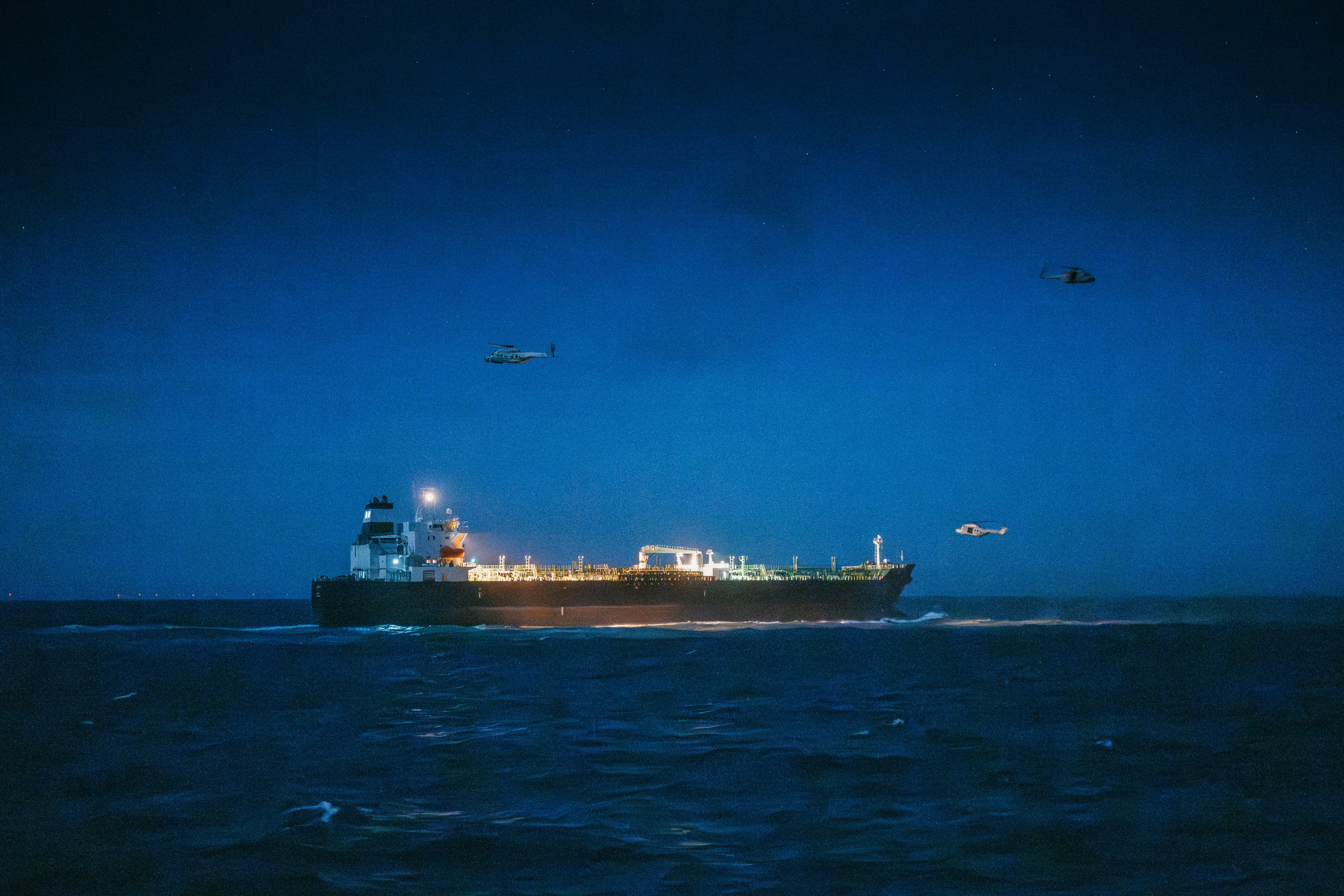 Belgian forces, with support from the French Navy, seized the Russian “shadow fleet” oil tanker MT Ethera on 28 February 2026. Photo: Belgian Ministry of Defence.
The LNG gap
The EU has committed to phasing out Russian energy imports by 2027, including natural gas. Yet its 20th sanctions package does not target European-owned, operated, or insured vessels transporting Russian liquefied natural gas (LNG).
Without parallel restrictions on EU-linked shipping, Russian LNG, particularly from the Yamal Peninsula, can continue to reach global markets. Icebreaker tankers, especially the specialised Arc7 fleet,remain central to this trade. Of the 15 Arc7 vessels currently in operation, 11 are owned or managed by European companies. In 2025, these firms facilitated more than 70% of LNG shipments between Yamal and Europe. Absent tighter measures, cargoes could simply be redirected to Asian or other markets at discounted prices, preserving a crucial revenue stream for Moscow.
If the EU is serious about closing loopholes in Russia’s energy trade, it may need to extend maritime service restrictions to LNG transport – and prevent European companies not only from carrying Russian gas, but also from transferring such vessels to Russian operators. Otherwise, sanctions on crude oil risk being partially offset by gas revenues.
Russia’s wartime economy and shadow fleet strategy are designed to intensify its war against Ukraine and weaken Europe as a whole. If Europe wants to be taken seriously, it should seize these vessels and extend its maritime services ban to LNG. Only such measures will meaningfully increase pressure on Moscow.